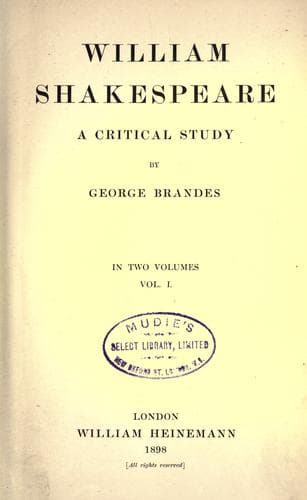
William Shakespeare: A Critical StudyBrandes, Georg
General
William Shakespeare: A Critical Study
Brandes, Georg
Shakespeare, William, 1564-1616 -- Criticism and interpretation
First and foremost, the play typifies Shakespeare's longing, the
longing of this great spirit, to get away from the unnatural city
life, away from the false and ungrateful city folk, intent on business
and on gain, away from flattery and falsehood and deceit, out into
the country, where simple manners still endure, where it is easier to
realise the dream of full freedom, and where the scent of the woods
is so sweet. There the babble of the brooks has a subtler eloquence
than any that is heard in cities; there the trees and even the stones
say more to the wanderer's heart than the houses and streets of the
capital; there he finds "good in everything."
The roving spirit has reawakened in his breast--the spirit which in
bygone days sent him wandering with his gun through Charlcote Park--and
out yonder in the lap of Nature, but in a remoter, richer Nature than that
which he has known, he dreams of a communion between the best and
ablest men, the fairest and most delicate women, in ideal fantastic
surroundings, far from the ugly clamours of a public career, and the
oppression of everyday cares. A life of hunting and song, and simple
repasts in the open air, accompanied with witty talk; and at the same
time a life full to the brim with the dreamy happiness of love. And
with this life, the creation of his roving spirit, his gaiety and his
longing for Nature, he animates a fantastic Forest of Arden.
But with this he is not content. He dreams out the dream, and feels
that even such an ideal and untrammelled life could not satisfy that
strange and unaccountable spirit lurking in the inmost depths of his
nature, which turns everything into food for melancholy and satire.
From this rib, then, taken from his own side, he creates the figure
of Jaques, unknown to the romance, and sets him wandering through his
pastoral comedy, lonely, retiring, self-absorbed, a misanthrope from
excess of tenderness, sensitiveness, and imagination.
Jaques is like the first light and brilliant pencil-sketch for Hamlet.
Taine, and others after him, have tried to draw a parallel between
Jaques and Alceste--of all Molière's creations, no doubt, the one who
contains most of his own nature. But there is no real analogy between
them. In Jaques everything wears the shimmering hues of wit and
fantasy, in Alceste everything is bitter earnest. Indignation is the
mainspring of Alceste's misanthropy. He is disgusted at the falsehood
around him, and outraged to see that the scoundrel with whom he is
at law, although despised by every one, is nevertheless everywhere
received with open arms. He declines to remain in bad company, even in
the hearts of his friends; therefore he withdraws from them. He loathes
two classes of people:
"Les uns parcequ'ils sont méchants et malfaisants,
Et les autres pour être aux méchants complaisants."
These are the accents of Timon of Athens, who hated the wicked for
their wickedness, and other men for not hating the wicked.
Public-domain text, read in full here on John Shaqi.
Reviews
Reviews
No reviews yet
Be the first to share your thoughts on this work.
Elsewhere in the archive
Join the Discussion
Join the discussion
Sign in to leave a comment or review.
Sign InorCreate an account