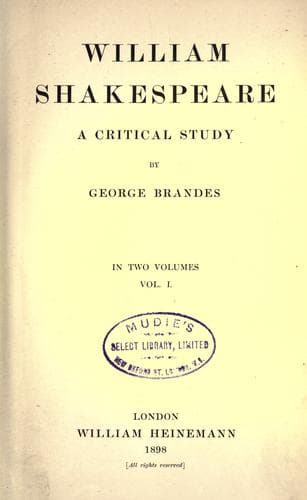
William Shakespeare: A Critical StudyBrandes, Georg
General
William Shakespeare: A Critical Study
Brandes, Georg
Shakespeare, William, 1564-1616 -- Criticism and interpretation
Ben Jonson is said to have inquired, in an epigram against the motto of
the Globe Theatre, where the spectators were to be found if all the men
and women were players? And an epigram attributed to Shakespeare gives
the simple answer that all are players and audience at one and the
same time. Jaques' survey of the life of man is admirably concise and
impressive. The last line--
"Sans teeth, sans eyes, sans taste, sans everything "--
with its half French equivalent for "without," is imitated from the
_Henriade_ of the French poet Gamier, which was not translated, and
which Shakespeare must consequently have read in the original.
This same Jaques, who gives evidence of so wide an outlook over human
life, is in daily intercourse, as we have said, nervously misanthropic
and formidably witty. He is sick of polite society, pines for solitude,
takes leave of a pleasant companion with the words: "I thank you for
your company; but, good faith, I had as lief have been myself alone."
Yet we must not take his melancholy and his misanthropy too seriously.
His melancholy is a comedy-melancholy, his misanthropy is only the
humourist's craving to give free vent to his satirical inspirations.
And there is, as aforesaid, only a certain part of Shakespeare's inmost
nature in this Jaques, a Shakespeare of the future, a Hamlet in germ,
but not that Shakespeare who now bathes in the sunlight and lives in
uninterrupted prosperity, in growing favour with the many, and borne
aloft by the admiration and goodwill of the few. We must seek for this
Shakespeare in the interspersed songs, in the drollery of the fool, in
the lovers' rhapsodies, in the enchanting babble of the ladies. He is,
like Providence, everywhere and nowhere.
When Celia says (i. 2), "Let us sit and mock the good house-wife,
Fortune, from her wheel, that her gifts may henceforth be bestowed
equally," she strikes, as though with a tuning-fork, the keynote of the
comedy. The sluice is opened for that torrent of jocund wit, shimmering
with all the rainbows of fancy, which is now to rush seething and
swirling along.
The Fool is essential to the scheme: for the Fool's stupidity is the
grindstone of wit, and the Fool's wit is the touchstone of character.
Hence his name.
The ways of the real world, however, are not forgotten. The good make
enemies by their very goodness, and the words of the old servant Adam
(Shakespeare's own part) to his young master Orlando (ii. 3), sound
sadly enough:--
"Your praise is come too swiftly home before you.
Know you not, master, to some kind of men
Their graces serve them but as enemies?
No more do yours: your virtues, gentle master,
Are sanctified, and holy traitors to you.
O, what a world is this, when what is comely
Envenoms him that bears it!"
Public-domain text, read in full here on John Shaqi.
Reviews
Reviews
No reviews yet
Be the first to share your thoughts on this work.
Elsewhere in the archive
Join the Discussion
Join the discussion
Sign in to leave a comment or review.
Sign InorCreate an account