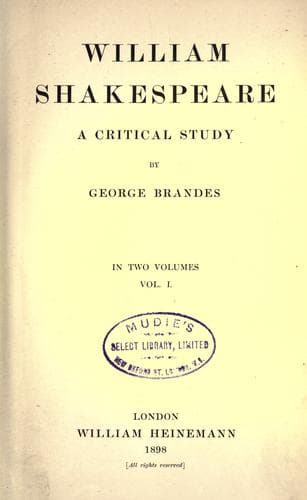
William Shakespeare: A Critical StudyBrandes, Georg
General
William Shakespeare: A Critical Study
Brandes, Georg
Shakespeare, William, 1564-1616 -- Criticism and interpretation
In moods of humorous melancholy, it must have seemed to Shakespeare as
though he himself were one of these jesters, who had the privilege of
uttering truths to great people and on the stage, if only they did not
blurt them out directly, but disguised them under a mask of folly. It
was in a similar mood that Heinrich Heine, centuries later, addressed
to the German people these words: "Ich bin dein Kunz von der Rosen,
dein Narr."
Therefore it is that Shakespeare makes Jaques exclaim--
"O, that I were a fool!
I am ambitious for a motley coat."
When the Duke answers, "Thou shalt have one," he declares that it is
the one thing he wants, and that the others must "weed their judgments"
of the opinion that he is wise:--
"I must have liberty
Withal, as large a charter as the wind,
To blow on whom I please; for so fools have:
And they that are most galled with my folly,
They most must laugh.
. . . . . . . .
Invest me in my motley: give me leave
To speak my mind, and I will through and through
Cleanse the foul body of the infected world,
If they will patiently receive my medicine."
It is Shakespeare's own mood that we hear in these words. The voice is
his. The utterance is far too large for Jaques: he is only a mouthpiece
for the poet. Or let us say that his figure dilates in such passages as
this, and we see in him a Hamlet _avant la lettre_.
When the Duke, in answer to this outburst, denies Jaques' right to
chide and satirise others, since he has himself been "a libertine,
As sensual as the brutish sting itself," the poet evidently defends
himself in the reply which he places in the mouth of the melancholy
philosopher:--
"Why, who cries out on pride,
That can therein tax any private party?
Doth it not flow as hugely as the sea,
Till that the weary very means do ebb?
What woman in the city do I name,
When that I say, the city-woman bears
The cost of princes on unworthy shoulders?
Who can come in, and say that I mean her,
When such a one as she, such is her neighbour?"
This exactly anticipates Holberg's self-defence in the character of
Philemon in _The Fortunate Shipwreck_. The poet is evidently rebutting
a common prejudice against his art. And as he makes Jaques an advocate
for the freedom which poetry must claim, so also, he employs him as a
champion of the actor's misjudged calling, in placing in his mouth the
magnificent speech on the Seven Ages of Man. Alluding, no doubt, to the
motto of _Totus Mundus Agit Histrionem_, inscribed under the Hercules
as Atlas, which was the sign of the Globe Theatre, this speech opens
with the words:--
"All the world's a stage,
And all the men and women merely players;
They have their exits and their entrances;
And one man in his time plays many parts."
Public-domain text, read in full here on John Shaqi.
Reviews
Reviews
No reviews yet
Be the first to share your thoughts on this work.
Elsewhere in the archive
Join the Discussion
Join the discussion
Sign in to leave a comment or review.
Sign InorCreate an account