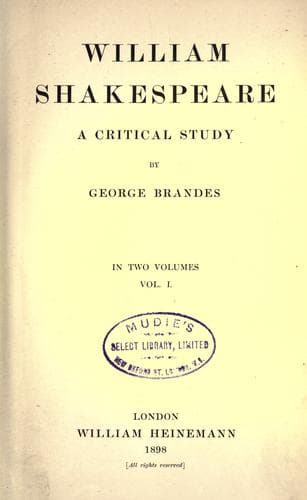
William Shakespeare: A Critical StudyBrandes, Georg
General
William Shakespeare: A Critical Study
Brandes, Georg
Shakespeare, William, 1564-1616 -- Criticism and interpretation
"_Orl_. Then, in mine own person, I die.
"_Ros_. No, 'faith, die by attorney. The poor world is
almost six thousand years old, and in all this time there
was not any man died in his own person, _videlicet_, in a
love-cause. Troilus had his brains dashed out with a Grecian
club; yet he did what he could to die before, and he is one
of the patterns of love. Leander, he would have lived many
a fair year, though Hero had turned nun, if it had not been
for a hot midsummer night; for, good youth, he went but
forth to wash him in the Hellespont, and, being taken with
the cramp, was drowned, and the foolish chroniclers of that
age found it was--Hero of Sestos. But these are all lies:
men have died from time to time, and worms have eaten them,
but not for love."
What Rosalind says of women in general applies to herself in
particular: you will never find her without an answer until you find
her without a tongue. And there is always a bright and merry fantasy in
her answers. She is literally radiant with youth, imagination, and the
joy of loving so passionately and being so passionately beloved. And it
is marvellous how thoroughly feminine is her wit. Too many of the witty
women in books written by men have a man's intelligence. Rosalind's wit
is tempered by feeling.
She has no monopoly of wit in this Arcadia of Arden. Every one in the
play is witty, even the so-called simpletons. It is a festival of wit.
At some points Shakespeare seems to have followed no stricter principle
than the simple one of making each interlocutor outbid the other in wit
(see, for example, the conversation between Touchstone and the country
wench whom he befools). The result is that the piece is bathed in a
sunshiny humour. And amid all the gay and airy wit-skirmishes, amid
the cooing love-duets of all the happy youths and maidens, the poet
intersperses the melancholy solos of his Jaques:--
"I have neither the scholar's melancholy, which is emulation; nor the
musician's, which is fantastical; nor the courtier's, which is proud;
nor the soldier's, which is ambitious; nor the lawyer's, which is
politic; nor the lady's, which is nice; nor the lover's, which is all
these; but it is a melancholy of mine own, compounded of many simples,
extracted from many objects."
This is the melancholy which haunts the thinker and the great creative
artist; but in Shakespeare it as yet modulated with ease into the most
engaging and delightful merriment.
[1] Reprinted in Hazlitt's Shakespeare's Library, ed. 1875, part i.
vol. ii.
XXIX
_CONSUMMATE SPIRITUAL HARMONY--TWELFTH NIGHT--JIBES AT PURITANISM--THE
LANGUISHING CHARACTERS--VIOLA'S INSINUATING GRACE--FAREWELL TO MIRTH_
Public-domain text, read in full here on John Shaqi.
Reviews
Reviews
No reviews yet
Be the first to share your thoughts on this work.
Elsewhere in the archive
Join the Discussion
Join the discussion
Sign in to leave a comment or review.
Sign InorCreate an account