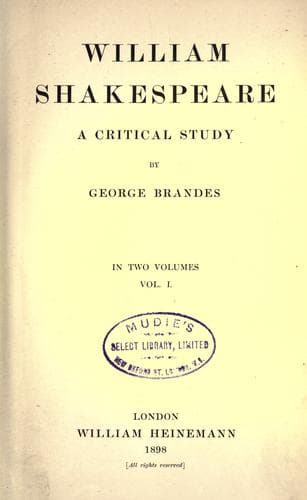
William Shakespeare: A Critical StudyBrandes, Georg
General
William Shakespeare: A Critical Study
Brandes, Georg
Shakespeare, William, 1564-1616 -- Criticism and interpretation
If the reader would picture to himself Shakespeare's mood during this
short space of time at the end of the old century and beginning of
the new, let him recall some morning when he has awakened with the
sensation of complete physical well-being, not only feeling no definite
or indefinite pain or uneasiness, but with a positive consciousness
of happy activity in all his organs: when he drew his breath lightly,
his head was clear and free, his heart beat peacefully: when the mere
act of living was a delight: when the soul dwelt on happy moments
in the past and dreamed of joys to come. Recall such a moment, and
then conceive it intensified an hundredfold--conceive your memory,
imagination, observation, acuteness, and power of expression a hundred
times multiplied--and you may divine Shakespeare's prevailing mood in
those days, when the brighter and happier sides of his nature were
turned to the sun.
There are days when the sun seems to have put on a new and festal
splendour, when the air is like a caress to the cheek, and when the
glamour of the moonlight seems doubly sweet; days when men appear
manlier and wittier, women fairer and more delicate than usual, and
when those who are disagreeable and even odious to us appear, not
formidable, but ludicrous--so that we feel ourselves exalted above the
level of our daily life, emancipated and happy. Such days Shakespeare
was now passing through.
It is at this period, too, that he makes sport of his adversaries the
Puritans without bitterness, with exquisite humour. Even in _As You
Like It_ (iii. 2), we find a little allusion to them, where Rosalind
says, "O most gentle Jupiter!--what tedious homily of love have you
wearied your parishioners withal, and never cried, 'Have patience, good
people!'" In his next play, the typical, solemn, and self-righteous
Puritan is held up to ridicule in the Don Quixote-like personage of the
moralising and pompous Malvolio, who is launched upon a billowy sea of
burlesque situations. Of course the poet goes to work with the greatest
circumspection. Sir Toby has made some inquiry about Malvolio, to which
Maria answers (ii. 3):--
"_Maria_. Marry, sir, sometimes he is a kind of Puritan.
"_Sir Andrew_. O! if I thought that, I'd beat him like a dog.
"_Sir Toby_. What, for being a Puritan? thy exquisite
reason, dear knight?
"_Sir And_. I have no exquisite reason for't, but I have
reason good enough.
"_Mar_. The devil a Puritan that he is, or anything
constantly but a time-pleaser; an affectioned ass, that cons
state without book, and utters it by great swarths."
Not otherwise does Molière expressly insist that Tartuffe is not a
clergyman, and Holberg that Jacob von Tyboe is not an officer.
Public-domain text, read in full here on John Shaqi.
Reviews
Reviews
No reviews yet
Be the first to share your thoughts on this work.
Elsewhere in the archive
Join the Discussion
Join the discussion
Sign in to leave a comment or review.
Sign InorCreate an account