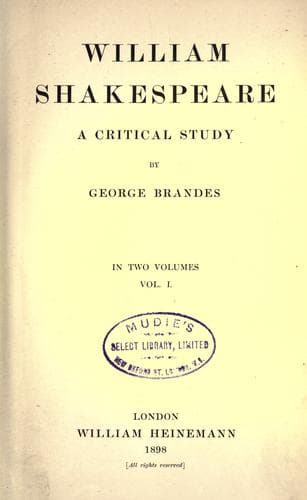
William Shakespeare: A Critical StudyBrandes, Georg
General
William Shakespeare: A Critical Study
Brandes, Georg
Shakespeare, William, 1564-1616 -- Criticism and interpretation
Twelfth Night, in Shakespeare's time, brought the Christmas festivities
of the upper classes to an end; among the common people they usually
lasted until Candlemas. On Twelfth Night all sorts of sports took
place. The one who chanced to find a bean baked into a cake was hailed
as the Bean King, chose himself a Bean Queen, introduced a reign of
unbridled frivolity, and issued whimsical commands, which had to be
punctually obeyed. Ulrici has sought to discover in this an indication
that the play represents a sort of lottery, in which Sebastian, the
Duke, and Maria chance to win the great prize. The bibulous Sir Toby,
however, can scarcely be regarded as a particularly desirable prize for
Maria; and the second title of the play, _What you Will_, indicates
that Shakespeare did not lay any stress upon the _Twelfth Night_.
This comedy is connected by certain filaments with its predecessor,
_As You Like It_. The passion which Viola, in her male attire, awakens
in Olivia, reminds us of that with which Rosalind inspires Phebe.
But the motive is quite differently handled. While Rosalind gaily
and unfeelingly repudiates Phebe's burning love, Viola is full of
tender compassion for the lady whom her disguise has led astray. In
the admirably worked-up confusion between Viola and her twin brother
Sebastian, an effect from the _Comedy of Errors_ is repeated; but the
different circumstances and method of treatment make this motive also
practically new.
With a careful and even affectionate hand, Shakespeare has elaborated
each one of the many characters in the play.
The amiable and gentle Duke languishes, sentimental and fancy-sick,
in hopeless enamourment. He is devoted to the fair Countess Olivia,
who will have nothing to say to him, and whom he none the less
besieges with his suit. An ardent lover of music, he turns to it for
consolation; and among the songs sung to him by the Clown and others,
there occurs the delicate little poem, of wonderful rhythmic beauty,
"Come away, come away, death." It exactly expresses the soft and
melting mood in which his days pass, lapped in a nerveless melancholy.
To the melody abiding in it we may apply the lovely words spoken by
Viola of the melody which preludes it:--
"It gives a very echo to the seat
Where love is throned."
In his fruitless passion, the Duke has become nervous and excitable,
inclined to violent self-contradictions. In one and the same scene (ii.
4) he first says that man's love is
"More giddy and unfirm,
More longing, wavering, sooner lost and worn"
than woman's; and then, a little further on, he says of his own love--
"There is no woman's sides
Can bide the beating of so strong a passion
As love doth give my heart; no woman's heart
So big to hold so much: they lack retention."
Public-domain text, read in full here on John Shaqi.
Reviews
Reviews
No reviews yet
Be the first to share your thoughts on this work.
Elsewhere in the archive
Join the Discussion
Join the discussion
Sign in to leave a comment or review.
Sign InorCreate an account