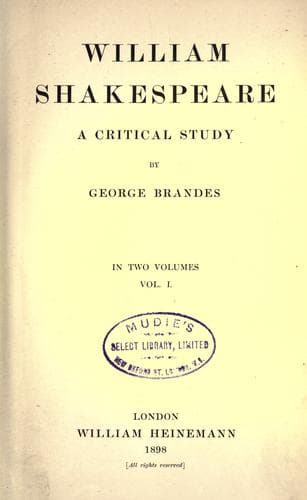
William Shakespeare: A Critical StudyBrandes, Georg
General
William Shakespeare: A Critical Study
Brandes, Georg
Shakespeare, William, 1564-1616 -- Criticism and interpretation
The matter of the play is found in a novel of Bandello's, translated
in Belleforest's _Histoires Tragiques_; and also in Barnabe Rich's
translation of Cinthio's _Hecatomithi_, published in 1581, which
Shakespeare appears to have used. The whole comic part of the action,
and the characters of Malvolio, Sir Toby, Sir Andrew Aguecheek, and the
Clown, are of Shakespeare's own invention.
There occurs in Ben Jonson's _Every Man out of his Humour_ a speech
which seems very like an allusion to _Twelfth Night;_ but as Jonson's
play is of earlier date, the speech, if the allusion be not fanciful,
must have been inserted later.[1]
As was to be expected, _Twelfth Night_ became exceedingly popular. The
learned Leonard Digges, the translator of Claudian, enumerating in
his verses, "Upon Master William Shakespeare" (1640), the poet's most
popular characters, mentions only three from the comedies, and these
from _Much Ado_ and _Twelfth Night_. He says:--
"Let but _Beatrice_
And _Benedicke_ be seene, loe in a trice
The Cockpit, Galleries, Boxes, all are full
To hear _Malvoglio_, that crosse garter'd Gull."
_Twelfth Night_ is perhaps the most graceful and harmonious comedy
Shakespeare ever wrote. It is certainly that in which all the notes the
poet strikes, the note of seriousness and of raillery, of passion, of
tenderness, and of laughter, blend in the richest and fullest concord.
It is like a symphony in which no strain can be dispensed with, or like
a picture veiled in a golden haze, into which all the colours resolve
themselves. The play does not overflow with wit and gaiety like its
predecessor; we feel that Shakespeare's joy of life has culminated and
is about to pass over into melancholy; but there is far more unity in
it than in _As You Like It_, and it is a great deal more dramatic.
A. W. Schlegel long ago made the penetrating observation that, in the
opening speech of the comedy, Shakespeare reminds us how the same word,
"fancy," was applied in his day both to love and to fancy in the modern
sense of the term; whence the critic argued, not without ingenuity,
that love, regarded as an affair of the imagination rather than of the
heart, is the fundamental theme running through all the variations of
the play. Others have since sought to prove that capricious fantasy is
the fundamental trait in the physiognomy of all the characters. Tieck
has compared the play to a great iridescent butterfly, fluttering
through pure blue air, and soaring in its golden glory from the
many-coloured flowers into the sunshine.
Public-domain text, read in full here on John Shaqi.
Reviews
Reviews
No reviews yet
Be the first to share your thoughts on this work.
Elsewhere in the archive
Join the Discussion
Join the discussion
Sign in to leave a comment or review.
Sign InorCreate an account