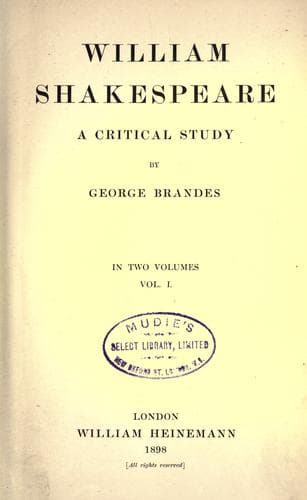
William Shakespeare: A Critical StudyBrandes, Georg
General
William Shakespeare: A Critical Study
Brandes, Georg
Shakespeare, William, 1564-1616 -- Criticism and interpretation
In harmony with the general tone of the play, the Clown is less witty
and more musical than Touchstone in _As You Like It._ He is keenly
alive to the dignity of his calling: "Foolery, sir, does walk about
the orb like the sun: it shines everywhere." He has many delightful
sayings, as for example, "Many a good hanging prevents a bad marriage,"
or the following demonstration (v. I) that one is the better for one's
foes, and the worse for one's friends:--
"Marry, sir, my friends praise me, and make an ass of me; now, my
foes tell me plainly I am an ass: so that by my foes, sir, I profit
in the knowledge of myself, and by my friends I am abused: so that,
conclusions to be as kisses, if your four negatives make your two
affirmatives, why then, the worse for my friends, and the better for my
foes."
Shakespeare even departs from his usual practice, and, as though to
guard against any misunderstanding on the part of his public, makes
Viola expound quite dogmatically that it "craves a kind of wit" to play
the fool (iii. I):--
"He must observe their mood on whom he jests,
The quality of persons, and the time,
And, like the haggard, check at every feather
That comes before his eye. This is a practice
As full of labour as a wise man's art."
The Clown forms a sort of connecting-link between the serious
characters and the exclusively comic figures of the play--the pair of
knights, Sir Toby Belch and Sir Andrew Aguecheek, who are entirely
of Shakespeare's own invention. They are sharply contrasted. Sir
Toby, sanguine, red-nosed, burly, a practical joker, always ready
for "a hair of the dog that bit him," a figure after the style of
Bellman;[2] Sir Andrew, pale as though with the ague, with thin, smooth,
straw-coloured hair, a wretched little nincompoop, who values himself
on his dancing and fencing, quarrelsome and chicken-hearted, boastful
and timid in the same breath, and grotesque in his every movement. He
is a mere echo and shadow of the heroes of his admiration, born to be
the sport of his associates, their puppet, and their butt; and while
he is so brainless as to think it possible he may win the love of the
beautiful Olivia, he has at the same time an inward suspicion of his
own stupidity which now and then comes in refreshingly: "Methinks
sometimes I have no more wit than a Christian or an ordinary man has;
but I am a great eater of beef, and, I believe, that does harm to my
wit" (i. 3). He does not understand the simplest phrase he hears, and
is such a mere reflex and parrot that "I too" is, as it were, the
watchword of his existence. Shakespeare has immortalised him once for
all in his reply when Sir Toby boasts that Maria adores him (ii. 3), "I
was adored once too." Sir Toby sums him up in the phrase:
"For Andrew, if he were opened, and you find so much blood in his liver
as will clog the foot of a flea, I'll eat the rest of the anatomy."
Public-domain text, read in full here on John Shaqi.
Reviews
Reviews
No reviews yet
Be the first to share your thoughts on this work.
Elsewhere in the archive
Join the Discussion
Join the discussion
Sign in to leave a comment or review.
Sign InorCreate an account