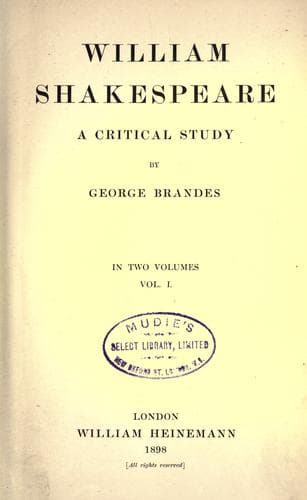
William Shakespeare: A Critical StudyBrandes, Georg
General
William Shakespeare: A Critical Study
Brandes, Georg
Shakespeare, William, 1564-1616 -- Criticism and interpretation
In short, if she were a man, she would display all the energy which the
Duke lacks. No wonder that, against her own will, she awakens Olivia's
love. She herself, as a woman, is condemned to passivity; her love
is wordless, deep, and patient. In spite of her sound understanding,
she is a creature of emotion. It is a very characteristic touch
when, in the scene (iii. 5) where Antonio, taking her for Sebastian,
recalls the services he has rendered, and begs for assistance in his
need, she exclaims that there is nothing, not even "lying vainness,
babbling drunkenness, or any taint of vice," that she hates so much
as ingratitude. However bright her intelligence, her soul from first
to last outshines it. Her incognito, which does not bring her joy as
it does to Rosalind, but only trouble and sorrow, conceals the most
delicate womanliness. She never, like Rosalind or Beatrice, utters an
audacious or wanton word. Her heart-winning charm more than makes up
for the high spirits and sparkling humour of the earlier heroines. She
is healthful and beautiful, like these her somewhat elder sisters;
and she has also their humorous eloquence, as she proves in her first
scene with Olivia. Yet there rests upon her lovely figure a tinge of
melancholy. She is an impersonation of that "farewell to mirth" which
an able English critic discerns in this last comedy of Shakespeare's
brightest years.[3]
[1] There is some (ironic) discussion of a possible criticism
that might be brought against a playwright: "That the argument of his
comedy might have been of some other nature, as of a duke to be in love
with a countess, and that countess to be in love with the duke's son,
and the son to love the lady's waiting-maid; some such cross wooing,
with a clown to their serving-man...."
[2] See the footnote 7 in chapter XXII:
"A dance of all the gods upon Olympus,
With fauns and graces and the muses twined."
From a poem by Tegnér on Bellman, the Swedish convivial lyrist.
[3] "It is in some sort a farewell to mirth, and the mirth
is of the finest quality, an incomparable ending. Shakespeare
has done greater things, but he has never done anything more
delightful."--_Arthur Symons._
XXX
_THE REVOLUTION IN SHAKESPEARE'S SOUL--THE GROWING MELANCHOLY OF THE
FOLLOWING PERIOD--PESSIMISM, MISANTHROPY_
For the time is now approaching when mirth, and even the joy of life,
are extinguished in his soul. Heavy clouds have massed themselves
on his mental horizon--their nature we can only divine--and gnawing
sorrows and disappointments have beset him. We see his melancholy
growing and extending; we observe its changing expressions, without
knowing its causes. This only we know, that the stage which he
contemplates with his mind's eye, like the material stage on which he
works, is now hung with black. A veil of melancholy descends over both.
Public-domain text, read in full here on John Shaqi.
Reviews
Reviews
No reviews yet
Be the first to share your thoughts on this work.
Elsewhere in the archive
Join the Discussion
Join the discussion
Sign in to leave a comment or review.
Sign InorCreate an account