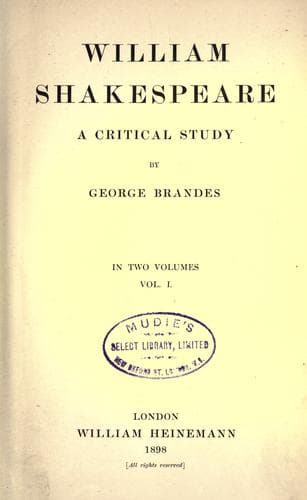
William Shakespeare: A Critical StudyBrandes, Georg
General
William Shakespeare: A Critical Study
Brandes, Georg
Shakespeare, William, 1564-1616 -- Criticism and interpretation
In _Hamlet_ Shakespeare's growing melancholy and bitterness take the
upper hand. For the hero, as for the poet, youth's bright outlook upon
life has been overclouded. Hamlet's belief and trust in mankind have
gone to wreck. Under the disguise of apparent madness, the melancholy
life-lore which Shakespeare, at his fortieth year, had stored up within
him, here finds expression in words of spiritual profundity such as had
not yet been thought or uttered in Northern Europe.
We catch a glimpse at this point of one of the subsidiary causes of
Shakespeare's melancholy. As actor and playwright he stands in a more
and more strained relation to the continually growing Free Church
movement of the age, to Puritanism, which he comes to regard as
nothing but narrow-mindedness and hypocrisy. It was the deadly enemy
of his calling; it secured, even in his lifetime, the prohibition of
theatrical performances in the provinces, a prohibition which after his
death was extended to the capital. From _Twelfth Night_ onwards, an
unremitting war against Puritanism, conceived as hypocrisy, is carried
on through _Hamlet,_ through the revised version of _All's Well that
Ends Well_, and through _Measure for Measure_, in which his wrath
rises to a tempestuous pitch, and creates a figure to which Molière's
Tartuffe can alone supply a parallel.
What struck him so forcibly in these years was the pitifulness of
earthly life, exposed as it is to disasters, not allotted by destiny,
but brought about by a conjunction of stupidity with malevolence.
It is especially the power of malevolence that now looms large before
his eyes. We see this in Hamlet's astonishment that it is possible for a
man "to smile and smile and be a villain." Still more strongly is it
apparent in _Measure for Measure_ (v. I):--
"Make not impossible
That which but seems unlike. 'Tis not impossible,
But one, the wicked'st caitiff on the ground,
May seem as shy, as grave, as just, as absolute,
As Angelo; even so may Angelo,
In all his dressings, characts, titles, forms,
Be an arch-villain."
It is this line of thought that leads to the conception of Iago,
Goneril, and Regan, and to the wild outbursts of Timon of Athens.
_Macbeth_ is Shakespeare's first attempt, after _Hamlet_, to explain
the tragedy of life as a product of brutality and wickedness in
conjunction--that is, of brutality multiplied and raised to the
highest power by wickedness. Lady Macbeth poisons her husband's mind.
Wickedness instils drops of venom into brutality, which, in its inward
essence, may be either weakness, or brave savagery, or stupidity
of manifold kinds. Whereupon brutality falls a-raving, and becomes
terrible to itself and others.
The same formula expresses the relation between Othello and Iago.
Public-domain text, read in full here on John Shaqi.
Reviews
Reviews
No reviews yet
Be the first to share your thoughts on this work.
Elsewhere in the archive
Join the Discussion
Join the discussion
Sign in to leave a comment or review.
Sign InorCreate an account