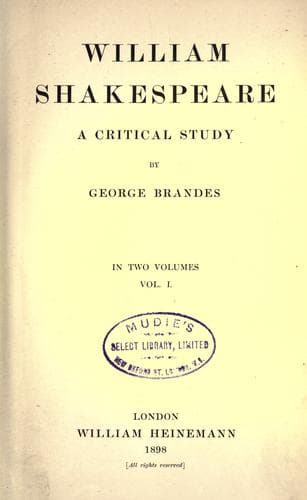
William Shakespeare: A Critical StudyBrandes, Georg
General
William Shakespeare: A Critical Study
Brandes, Georg
Shakespeare, William, 1564-1616 -- Criticism and interpretation
_Othello_ was a monograph. _Lear_ is a world-picture. Shakespeare turns
from _Othello_ to _Lear_ in virtue of the artist's need to supplement
himself, to follow up every creation with its counterpart or foil.
_Lear_ is the greatest problem Shakespeare had yet proposed to himself,
all the agonies and horrors of the world compressed into five short
acts. The impression of _Lear_ may be summed up in the words: a
world-catastrophe. Shakespeare is no longer minded to depict anything
else. What is echoing in his ears, what is filling his mind, is the
crash of a ruining world.
This becomes even clearer in his next play, _Antony and Cleopatra._
This subject enabled him to set new words to the music within him.
In the history of Mark Antony he saw the deep downfall of the old
world-republic--the might of Rome, austere and rigorous, collapsing at
the touch of Eastern luxury.
By the time Shakespeare had written _Antony and Cleopatra,_ his
melancholy had deepened into pessimism. Contempt becomes his abiding
mood, an all-embracing scorn for mankind, which impregnates every drop
of blood in his veins, but a potent and creative scorn, which hurls
forth thunderbolt after thunderbolt. _Troilus and Cressida_ strikes at
the relation of the sexes, _Coriolanus_ at political life; until all
that, in these years, Shakespeare has endured and experienced, thought
and suffered, is concentrated into the one great despairing figure of
Timon of Athens, "misanthropos," whose savage rhetoric is like a dark
secretion of clotted blood and gall, drawn off to assuage pain.
BOOK SECOND
I
_INTRODUCTION--THE ENGLAND OF ELIZABETH IN SHAKESPEARE'S YOUTH_
Everything had flourished in the England of Elizabeth while Shakespeare
was young. The sense of belonging to a people which, with great
memories and achievements behind it, was now making a decisive and
irresistible new departure--the consciousness of living in an age when
the glorious culture of antiquity was being resuscitated, and when
great personalities were vindicating for England a lofty and assured
position, alike in the practical and in the intellectual departments
of life--these feelings mingled in his breast with the vernal glow of
youth itself. He saw the star of his fatherland ascending, with his own
star in its train.
Public-domain text, read in full here on John Shaqi.
Reviews
Reviews
No reviews yet
Be the first to share your thoughts on this work.
Elsewhere in the archive
Join the Discussion
Join the discussion
Sign in to leave a comment or review.
Sign InorCreate an account