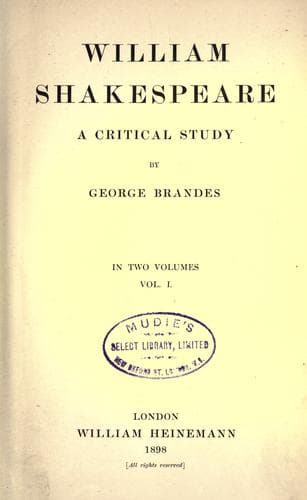
William Shakespeare: A Critical StudyBrandes, Georg
General
William Shakespeare: A Critical Study
Brandes, Georg
Shakespeare, William, 1564-1616 -- Criticism and interpretation
It seemed to him as though men and women had in that day richer
abilities, a more daring spirit, and fuller powers of enjoyment than
they had possessed in former times. They had more fire in their blood,
more insatiable longings, a keener appetite for adventure, than the
men and women of the past. They knew how to rule with courage and
wisdom, like the Queen and Lord Burghley; how to live nobly and fight
gloriously, to love with passion and sing with enthusiasm, like the
beautiful hero of the younger generation, Sir Philip Sidney, who found
an early Achilles-death. They were bent on enjoying existence with all
their senses, comprehending it with all their powers, revelling in
wealth and splendour, in beauty and wit; or they set forth to voyage
round the world, to see its marvels, conquer its treasures, give their
names to new countries, and display the flag of England on unknown seas.
Statesmanship and generalship were represented among them by the men
who, in these years, had humbled Spain, rescued Holland, held Scotland
in awe. They were sound and vigorous natures. Although they all had the
literary proclivities of the Renaissance, they were before everything
practical men, keen observers of the signs of the times, firm and wary
in adversity, in prosperity prudent and temperate.
Shakespeare had seen Spenser's faithful friend, Sir Walter Raleigh,
next to himself and Francis Bacon the most brilliant and interesting
Englishman of his day, after covering himself with renown as a soldier,
a viking, and a discoverer, win the favour of Elizabeth as a courtier,
and the admiration of the people as a hero and poet. Shakespeare no
doubt laid to heart these lines in his elegy on Sidney:--
"England doth hold thy limbs, that bred the same;
Flanders thy valour, where it last was tried;
The camp thy sorrow, where thy body died:
Thy friends thy want; the world thy virtues' fame."
For Raleigh, too, was a poet, as well as an orator and historian.
"We picture him to ourselves," says Macaulay, "sometimes reviewing
the Queen's guard, sometimes giving chase to a Spanish galleon, then
answering the chiefs of the country party in the House of Commons, then
again murmuring one of his sweet lovesongs too near the ears of her
Highness's maids of honour, and soon after poring over the Talmud, or
collating Polybius with Livy."[1]
Public-domain text, read in full here on John Shaqi.
Reviews
Reviews
No reviews yet
Be the first to share your thoughts on this work.
Elsewhere in the archive
Join the Discussion
Join the discussion
Sign in to leave a comment or review.
Sign InorCreate an account