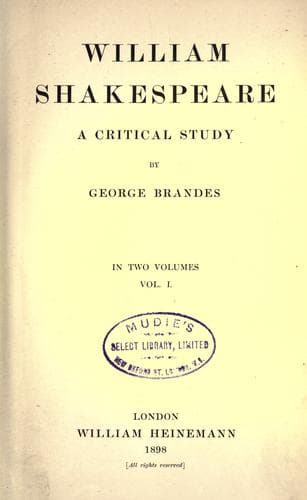
William Shakespeare: A Critical StudyBrandes, Georg
General
William Shakespeare: A Critical Study
Brandes, Georg
Shakespeare, William, 1564-1616 -- Criticism and interpretation
In some respects, however, Elizabeth in her later years had made
progress in the art of government. So weak had been her faith in the
warlike capabilities of her country, and so potent, on the other hand,
her avarice, that she had neglected to make preparation for the war
with Spain, and had left her gallant seamen inadequately equipped; but
after the victory over the Spanish Armada she ungrudgingly devoted
all the resources of her treasury to the war, which survived her and
extended well into the following century. This war had forced Elizabeth
to take a side in the internal religious dissensions of the country.
She was the head of the Church, regarded ecclesiastical affairs as
subject to her personal control, and, so far as she was able, would
suffer no discussion of religious questions in the House of Commons.
Like her contemporary Henri Quatre of France, she was in her heart
entirely indifferent to religion, had a certain general belief in God,
but thought all dogmas mere cobwebs of the brain, and held one rite
neither better nor worse than another. They both regarded religious
differences exclusively from the political point of view. Henry ended
by becoming a Catholic and assuring his former co-religionists freedom
of conscience. Elizabeth was of necessity a Protestant, but tolerance
was an unknown doctrine in England. It was an established principle that
every subject must accept the religion of the State.
Authoritarian to her inmost fibre, Elizabeth had a strong bent
towards Catholicism. The circumstances of her life had placed her in
opposition to the Papal power, but she was fond of describing herself
to foreign ambassadors as a Catholic in all points except subjection
to the Pope. She did not even make any secret of her contempt for
Protestantism, whose head she was, and whose support she could not for
a moment dispense with. She felt it a humiliation to be regarded as a
co-religionist of the French, Scotch, or Dutch heretics. She looked
down upon the Anglican Bishops whom she had herself appointed, and
they, in their worldliness, deserved her scorn. But still deeper was
her detestation of all sectarianism within the limits of her Church,
and especially of Puritanism in all its forms. If she did not in the
first years of her reign indulge in open persecution of the Puritans,
it was only because she was as yet dependent on their support; but as
soon as she felt herself firmly seated on her throne, she established,
in spite of the stiff-necked opposition of Parliament, the jurisdiction
of the Bishops on all matters of ecclesiastical politics, and suffered
Puritan writers to be condemned to death or lifelong imprisonment for
free but quite innocent expressions of opinion regarding the relation
of the State to religion.
Public-domain text, read in full here on John Shaqi.
Reviews
Reviews
No reviews yet
Be the first to share your thoughts on this work.
Elsewhere in the archive
Join the Discussion
Join the discussion
Sign in to leave a comment or review.
Sign InorCreate an account