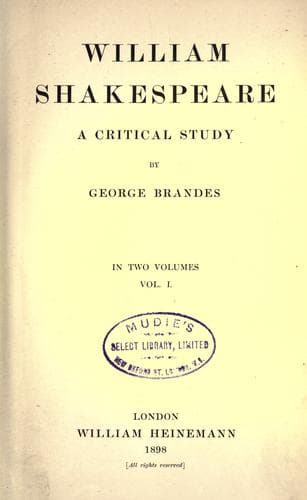
William Shakespeare: A Critical StudyBrandes, Georg
General
William Shakespeare: A Critical Study
Brandes, Georg
Shakespeare, William, 1564-1616 -- Criticism and interpretation
Her greatness had mainly reposed upon the insight she had shown in the
choice of her counsellors and commanders. But the most distinguished
of those who had shed glory on her throne died one after the other in
the last decade of the century. The first to die was Walsingham, one
of her most disinterested servants, whom she had repaid with black
ingratitude. He had done her great and loyal services, and had saved
her life at the time of the last conspiracy, which led to the execution
of Mary Stuart. Then she lost such notable members of her Council as
Lord Hunsdon and Sir Francis Knowles; then Lord Burghley himself, the
true ruler of England during her reign; and finally, Sir Francis Drake,
the great naval hero of the war with Spain. She felt herself lonely and
deserted. She no longer took any pleasure in the position of power to
which England had attained under her rule. In spite of all she could
do to conceal it, she began to feel the oppression of age, and to
see how little real affection those men felt for her who were always
posing in the light of adorers. She was the last of her line, and the
thought of her successor was so intolerable to her, that she deferred
his final nomination until she lay on her death-bed. But it availed her
nothing; she knew very well that her ministers and courtiers, during
the last years of her life, were in constant and secret communication
with James of Scotland. They would kneel in the dust as she passed
with exclamations of enchantment at her youthful appearance, and then
rise, brush the dust from their knees, and write to James that the
Queen looked ghastly and could not possibly last long. They did all
they possibly could to conceal from her their Scotch intrigues; but she
divined what went on behind her back, even if she did not realise the
extent to which it was carried, or know definitely which of her most
trusted servants were shrinking from nothing that could assure them the
favour of James. For example, she did not suspect Robert Cecil of the
double game he was carrying on, at the very time when he was doing his
best to drive Essex to desperation and secure his punishment for an
act of disobedience scarcely more heinous in the Queen's eyes than his
own underhand dealings. But she felt herself isolated in the midst of
a crowd of courtiers impatiently awaiting the new era that was to dawn
after her death. She realised that the men who still flattered her had
never been attached to her for her own sake, and she specially resented
the fact that they no longer seemed even to fear her.
One result of this deep dejection was that she gave her tyrannical
tendencies a freer course than before, and became less and less
inclined to forbearance or mercy towards those who had once been dear
to her but had fallen into disgrace.
Public-domain text, read in full here on John Shaqi.
Reviews
Reviews
No reviews yet
Be the first to share your thoughts on this work.
Elsewhere in the archive
Join the Discussion
Join the discussion
Sign in to leave a comment or review.
Sign InorCreate an account