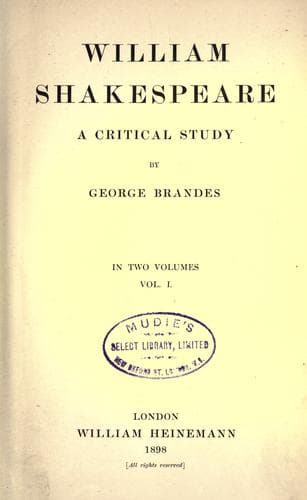
William Shakespeare: A Critical StudyBrandes, Georg
General
William Shakespeare: A Critical Study
Brandes, Georg
Shakespeare, William, 1564-1616 -- Criticism and interpretation
She had always taken it very ill when one of her favourites showed
any inclination towards matrimony, and they had therefore always been
forced to marry secretly, though that did not in the end save them from
her displeasure. Now her despotism rose to such a pitch that she wanted
to control the marriages even of those courtiers who had never enjoyed
her favour.
One of the things which Shakespeare doubtless took most to heart at the
end of the old century and beginning of the new was the hard fate which
overtook his distinguished and highly valued patron Southampton. This
nobleman had fallen in love with Essex's cousin, the Lady Elizabeth
Vernon. The Queen forbade him to marry her, but he would not relinquish
his bride. He was hot-headed and high-spirited. Young as he was, he had
boarded and taken a Spanish ship of war in the course of the expedition
commanded by his friend Essex. Once, in the palace itself, when
Southampton, Raleigh, and another courtier had been laughing and making
a noise over a game of primero, the captain of the guard, Ambrose
Willoughby, called them to order because the Queen had gone early to
bed; whereupon Southampton struck this high official in the face and
actually had a bout of fisticuffs with him. Such being his character,
we cannot wonder that he contracted a private marriage in spite of the
prohibition (August 1598). Elizabeth sent him to pass his honeymoon in
the Tower, and thenceforth viewed him with high disfavour.
His close relationship to Essex led to a new outburst of the Queen's
displeasure. When Essex took command of the army in Ireland in
1599, he appointed Southampton his General of Horse; but simply out
of resentment for Southampton's disobedience in the matter of his
marriage, the Queen forced Essex to rescind the appointment.
One must bear in mind, among other things, this attitude of the Queen
towards Shakespeare's first patron in order to understand the evident
coolness of his feeling towards Elizabeth. He did not, for example,
join in the threnodies of the other English poets on her death, and
even after Chettle had expressly urged him,[2] refrained from writing
a single line in her praise. He probably read her character much as
Froude did in our own day.
Public-domain text, read in full here on John Shaqi.
Reviews
Reviews
No reviews yet
Be the first to share your thoughts on this work.
Elsewhere in the archive
Join the Discussion
Join the discussion
Sign in to leave a comment or review.
Sign InorCreate an account