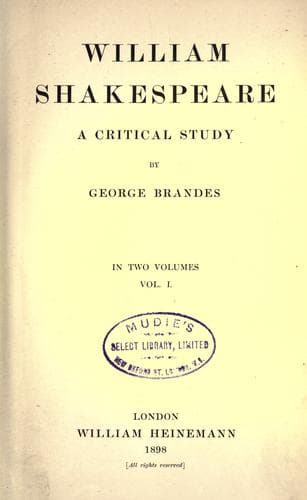
William Shakespeare: A Critical StudyBrandes, Georg
General
William Shakespeare: A Critical Study
Brandes, Georg
Shakespeare, William, 1564-1616 -- Criticism and interpretation
At the time of the Armada, therefore, the Queen kept him at court,
much against his own will. Nor would he have been allowed to take
part in the war of 1589 if he had not secretly made his escape from
England, leaving behind him a letter to the Queen and Council to the
effect that "he would return alive at no one's bidding." An angry
letter from Elizabeth forced him, however, to come back after he had
distinguished himself before Lisbon. They were then reconciled, but the
practical-minded Queen immediately demanded of him the repayment of a
sum of £3000 which she had lent him, so that he was forced to sell his
mansion of Keyston. He received in return "the farm of sweet wines," a
very lucrative monopoly, the withdrawal of which many years afterwards
led to the boiling over of his discontent.
We have seen how his secret marriage in 1590 enraged the Queen, who
at once vented her wrath upon his bride. Presently, however, he was
once more in favour, and in the middle of the French campaign of 1591,
Elizabeth recalled him to England for a week, which was passed in all
sorts of festivities. She wept when he returned to the army, and laid
upon him an injunction, to which he paid very little heed, that he must
on no account incur any personal danger.
During the subsequent four years which Essex passed in England,
occupied with his plans of ambition, it became clear to him that
Burghley's son, Sir Robert Cecil, was the chief obstacle to his
advancement. All of those, therefore, who for one reason or another
hated the house of Cecil, cast in their lot with Essex. Thus it
happened that Cecil's cousin, Francis Bacon, who had in vain besought
first the father and then the son for some profitable office, became
a close personal adherent of Essex. It was necessary to make choice
of one party or the other if you were to hope for any preferment. In
the years 1593 and 1594, accordingly, we find Essex again and again
importuning Elizabeth for offices for Bacon. She had no very great
confidence in Bacon, and bore him a grudge, moreover, because he had
incautiously spoken in Parliament against a Government measure; so
that Essex, to his great annoyance and disgust, met with a refusal to
all his applications. As a consolation to his client, he made him a
present of land to the value of not less than £1800. That was the price
for which Bacon sold the property; Essex had believed it to be worth
more.[1] This gift, we see, was nearly twice as large as that which
Southampton is reported to have made to Shakespeare (see above, p. 152).
Public-domain text, read in full here on John Shaqi.
Reviews
Reviews
No reviews yet
Be the first to share your thoughts on this work.
Elsewhere in the archive
Join the Discussion
Join the discussion
Sign in to leave a comment or review.
Sign InorCreate an account