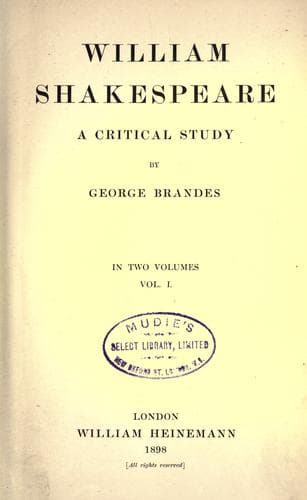
William Shakespeare: A Critical StudyBrandes, Georg
General
William Shakespeare: A Critical Study
Brandes, Georg
Shakespeare, William, 1564-1616 -- Criticism and interpretation
Henceforward Bacon is to be regarded as an attentive and officious
adherent of Essex, while Essex makes it a point of honour to obtain for
him every recognition, preferment, and advantage. Again and again Bacon
places his pen at the disposal of Essex. There are extant three long
letters from Essex to his young cousin Lord Rutland, dated 1596, giving
him excellent advice as to how to reap most profit from his first
Continental tour, on which he was then setting out. In many passages
of these letters we recognise Bacon's ideas, and in some his style,
his acknowledged writings containing almost identical parallels. The
probability is that in these, as in many subsequent instances, Bacon
supplied Essex with the ideas and the first draft of the letters. Well
knowing that the Queen's dissatisfaction with Essex arose chiefly from
his desire for military glory and the popularity which follows in its
train--well knowing, too, that Essex's enemies at court were always
representing this ambition to the Queen as a hindrance to the peace
with Spain, which nevertheless must one day be concluded--Bacon thought
it a good move for his protector to display unequivocally his care for
the occupations of peace, the acquisition of useful knowledge, and
other unmilitary advantages, in letters which, although private, were
likely enough to come into her Majesty's hands.
Francis Bacon's brother, Anthony, about the same time attached
himself closely (and more faithfully) to Essex. Through him the Earl
established communications with all the foreign courts, so that for a
time his knowledge of European affairs rivalled that of the Foreign
Ministry itself.
The zeal which Essex had displayed in unravelling Doctor Roderigo
Lopez's suspected plot against Elizabeth (see above, p. 191) had placed
him very high in her renewed favour. His heroic exploits at Cadiz ought
to have strengthened his position; but his adversary, Robert Cecil,
had during his absence acquired new power, and the rapacious Elizabeth
complained of the smallness of the booty (it amounted to £13,000). As
a matter of fact, Essex alone had wanted to follow up the advantage
gained, and to seize the Indian fleet, which was allowed to escape: he
had been out-voted in the council of war.
In order to overcome this new resentment on the Queen's part, Bacon,
who regarded his fate as bound up in that of the Earl, wrote a letter
to Essex (dated October 4, 1596), full of good advice with respect
to the attitude he ought to adopt towards Elizabeth, especially
in order to disabuse her mind of the idea that his disposition
was ungovernable--advice which Bacon himself, with his courtier
temperament, might easily enough have followed, but which was too hard
for the downright Essex, who had no sooner made humble submission than
his pride again brought arrogant expressions to his lips.
Public-domain text, read in full here on John Shaqi.
Reviews
Reviews
No reviews yet
Be the first to share your thoughts on this work.
Elsewhere in the archive
Join the Discussion
Join the discussion
Sign in to leave a comment or review.
Sign InorCreate an account