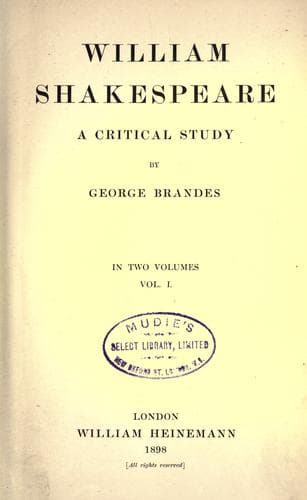
William Shakespeare: A Critical StudyBrandes, Georg
General
William Shakespeare: A Critical Study
Brandes, Georg
Shakespeare, William, 1564-1616 -- Criticism and interpretation
At the close of the year 1596 Bacon's protector was accused by his
client's mother, Lady Bacon, of misconduct with one of the ladies of
the court. He denied the charge, but confessed to "similar errors."
In 1597 Essex, who had been longing for a new command, undertook an
expedition to the Azores with twenty ships and 6000 men--an enterprise
which, largely owing to his inexperience and unfortunate leadership,
was entirely unsuccessful. On his return he was very coldly received
by the Queen, especially on the ground that towards the end of the
expedition he had behaved ill to Raleigh, his colleague in command.
In order to make his peace with Elizabeth, he sent her insinuating
letters; but he was mortally offended when the eminent services of the
old Lord Howard were rewarded by the appointment of Lord High Admiral.
As the victor of Cadiz, he regarded himself as the one possible man
for this distinction, which gave Howard precedence over him. He
bemoaned his fate, however, to such purpose that he soon after secured
the appointment of Earl Marshal of England, which in turn gave him
precedence over Howard. He received a very valuable present--worth
£7000--and for the first and last time induced the Queen to grant an
audience to his mother, Lady Lettice, whose marriage with Leicester,
twenty-three years before, was not yet forgiven, although in 1589, at
the age of forty-nine, she had married a third husband, Sir Christopher
Blount.
But Essex was not long at peace with the Queen and Court. In 1598 he
was accused of illicit relations with no fewer than four ladies of the
court (Elizabeth Southwell, Elizabeth Brydges, Mrs. Russell, and Lady
Mary Howard), and the charge seems to have been well founded. At the
same time violent dissensions broke out as to whether an attempt should
or should not be made to bring the war with Spain to a close. Essex
carried the day, and it was continued. It was at this time that he
wrote a pamphlet defending himself warmly from the charge of desiring
war at any price. It was not published until 1602, under the title:
_An apology of the Earle of Essex against those which jealously and
maliciously tax him to be the hinderer of the peace and quiet of his
country._
To the Queen's birthday of this year (November 17, 1598) belongs an
anecdote which shows what ingenuity Essex displayed in annoying his
rival. As was the custom of the day, the leading courtiers tilted at
the ring in honour of her Majesty, and each knight was required to
appear in some disguise. It was known, however, that Sir Walter Raleigh
would ride in his own uniform of orange-tawny medley, trimmed with
black budge of lamb's wool. Essex, to vex him, came to the lists with
a body-guard of two thousand retainers all dressed in orange-tawny,
so that Raleigh and his men seemed only an insignificant division of
Essex's splendid retinue.[2]
Public-domain text, read in full here on John Shaqi.
Reviews
Reviews
No reviews yet
Be the first to share your thoughts on this work.
Elsewhere in the archive
Join the Discussion
Join the discussion
Sign in to leave a comment or review.
Sign InorCreate an account