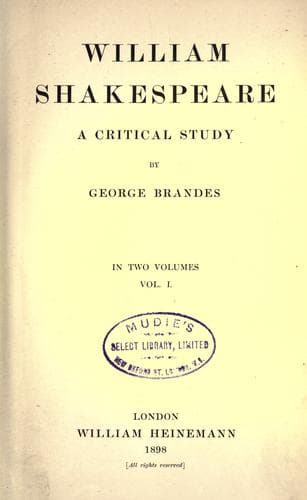
William Shakespeare: A Critical StudyBrandes, Georg
General
William Shakespeare: A Critical Study
Brandes, Georg
Shakespeare, William, 1564-1616 -- Criticism and interpretation
In March 1599 Essex took the command of the English troops; he was to
suppress the rebellion and grant Tyrone his life only on condition
of his complete surrender. But instead of carrying out his orders,
which were to attack the rebels in their stronghold, Ulster, Essex
remained for long inactive, and at last marched into Munster. One of
his subordinate officers, Sir Henry Harington, suffered a disgraceful
defeat, partly through his own incompetence, partly through the
cowardice of his officers and men. He was tried by court-martial in
Dublin, and he himself, and every tenth man of his command, were shot.
The summer slipped away, and in its course the 16,000 men with whom
Essex had come to Ireland were reduced by sickness and desertion to
a quarter of their original number. Under these circumstances, Essex
again deferred his march upon Ulster, so that the Queen, who was
excessively displeased, expressly forbade him to return from Ireland
without her permission.
When at last, in the beginning of September 1599, he confronted with
his shrunken forces Tyrone's unbreathed army, which had taken up a
strong position to await the coming of the English, he abandoned
his plan of attack, invited Tyrone to a parley, had half an hour's
conversation with him on the 6th of September, and concluded a fourteen
weeks' armistice, to be renewed every six weeks until the 1st of May.
According to his own account, he promised Tyrone that this treaty
should not be placed in writing, lest it should fall into the hands of
the Spaniards and be used against him.
This was certainly not what Elizabeth had expected of the Irish
campaign, which had opened with such a flourish of trumpets, and we
cannot wonder that her anger was fierce and deep-seated. No sooner had
she received the intelligence, than she forbade the conclusion of any
treaty whatsoever.
Convinced that his enemies now had the entire ear of the Queen, Essex
sought safety in once more disobeying Elizabeth's express command. With
a train of only six followers, which in the indictment against him
afterwards grew into a body of 200 picked men, he crossed to England
to attempt his own justification, rode direct to Nonsuch Palace, where
Elizabeth then was, forced all the doors, and, travel-stained as he
was, threw himself on his knees before the Queen, whom he surprised in
her bed-chamber, with her hair undressed, at ten o'clock in the morning
of the 28th of September.
Public-domain text, read in full here on John Shaqi.
Reviews
Reviews
No reviews yet
Be the first to share your thoughts on this work.
Elsewhere in the archive
Join the Discussion
Join the discussion
Sign in to leave a comment or review.
Sign InorCreate an account