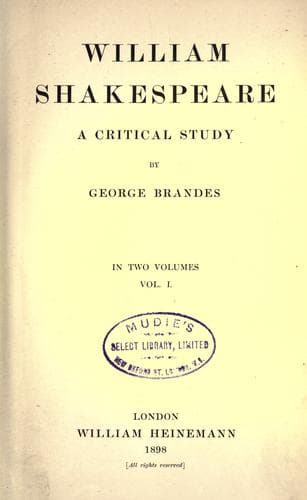
William Shakespeare: A Critical StudyBrandes, Georg
General
William Shakespeare: A Critical Study
Brandes, Georg
Shakespeare, William, 1564-1616 -- Criticism and interpretation
It is a strong proof of the power which his personality still retained
over Elizabeth, that at the first moment she felt nothing but pleasure
in seeing him. As soon as he had changed his clothes, he was admitted
to an audience, which lasted an hour and a half. As yet all seemed
well. He dined at the Queen's table and told her about Ireland and its
people. But in the evening he was "commanded to keep his chamber" until
the lords of the Council should have spoken with him; and a few days
later he was confined to York House, with his friend the Lord Keeper,
however, for his gaoler.
He presently fell ill, when it appeared that the Queen had by no means
forgotten her former tenderness for him. In the middle of December she
sent eight physicians to consult as to his case. They despaired of his
life, but he recovered.
While matters thus looked very black for Essex, his nearest friends
also were, of course, in disgrace. In a letter from Rowland Whyte to
Sir Robert Sidney (dated October 11, 1599), we find the following
significant statement: "My Lord _Southhampton_, and Lord _Rutland_ come
not to the court; the one doth but very seldome; they pass away the
Tyme in _London_ merely in going to Plaies euery day."[3] Southampton
had married a cousin of Essex, and Rutland a daughter of Lady Essex by
her first marriage with Sir Philip Sidney; so that both were in the
same boat with their more distinguished kinsman.
On the 5th of June 1600, Essex was brought to trial--not before the
Star Chamber, but, by particular favour, before a special court,
consisting of four earls, two barons, and four judges, which assembled
at the Lord Keeper's residence, York House, the general public being
excluded. The procedure was mainly dictated by the Queen's wish to
justify the arrest of Essex in the face of public opinion, which
idolised him and regarded him as a martyr.
[1] James Spedding: _Letters and Life of Francis Bacon_, i. 371.
[2] Gosse: _Raleigh_, p. 113.
[3] A. Collins: _Letters and Memorials of State_, ii. 132.
IV
_THE FATE OF ESSEX AND SOUTHAMPTON_
Public-domain text, read in full here on John Shaqi.
Reviews
Reviews
No reviews yet
Be the first to share your thoughts on this work.
Elsewhere in the archive
Join the Discussion
Join the discussion
Sign in to leave a comment or review.
Sign InorCreate an account