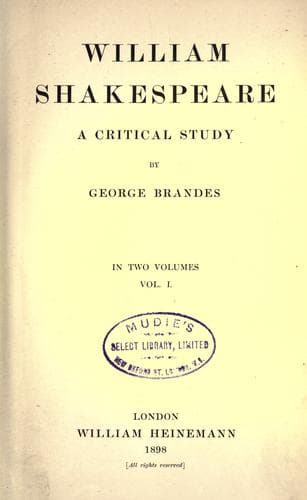
William Shakespeare: A Critical StudyBrandes, Georg
General
William Shakespeare: A Critical Study
Brandes, Georg
Shakespeare, William, 1564-1616 -- Criticism and interpretation
Essex made only confused replies: his life was threatened, he was to
be murdered in his bed, he had been treacherously dealt with, and so
forth. In the meantime shouts arose from the crowd of his retainers,
"Away, my lord; they abuse you, they betray you, they undo you; you
lose time!" Essex led the noblemen into his house amid cries from
his armed friends of "Kill them, kill them!" and "Shut them up! Keep
them as pledges, cast the great seal out at the window!" He had them
locked up in his library as prisoners or hostages. Then he came out
again, and, amid cries of "To Court! to Court!" his party rushed
through the gates. At the last moment, Essex learned that the Court
was prepared, the watch was doubled, and every access to Whitehall was
barred. They were therefore forced to attempt, in the first place, to
stir up an insurrection in the city. But in order to pass through the
streets horses were needed; they were sent for, but there was delay in
procuring them. So impatient was every one by this time, that instead
of awaiting their arrival, several hundred men, headed by Essex,
Southampton, Rutland, Blount, and other gentlemen, but without any
real leader or effective plan of action, set off for the city. Essex
nowhere made any speech to the populace, but merely shouted, as though
beside himself, that an attempt had been made to murder him. A good
many people, indeed, appeared to join him, but none of them were armed,
and they were in reality no more than onlookers. In the meantime,
the Government despatched high officials on horseback to different
quarters of the town to proclaim Essex a traitor; whereupon many of
his following deserted him. Troops, too, were despatched against him,
so that he, with the remainder of his band, with difficulty made their
way by water back to Essex House, which was immediately besieged and
fired upon. In the evening Essex and Southampton opened negotiations,
and about ten o'clock surrendered with their little force, on the
understanding that they should be courteously treated and accorded an
honourable trial. The prisoners were taken to the Tower.
Francis Bacon now again plays a part, and this time a decisive one,
in Essex's history. There was no need for him to take any share in
the trial; and even if his office had imposed it upon him, he ought
in common decency to have refrained. He was neither Attorney-General
nor Solicitor, but only one of the "Learned Counsel." The very fact of
his close friendship with Essex, however, made the Government anxious
that he should appear in the case. He was at once advocate and witness,
and was not summoned as one of the learned counsel, but expressly as
"friend to the accused."
Public-domain text, read in full here on John Shaqi.
Reviews
Reviews
No reviews yet
Be the first to share your thoughts on this work.
Elsewhere in the archive
Join the Discussion
Join the discussion
Sign in to leave a comment or review.
Sign InorCreate an account