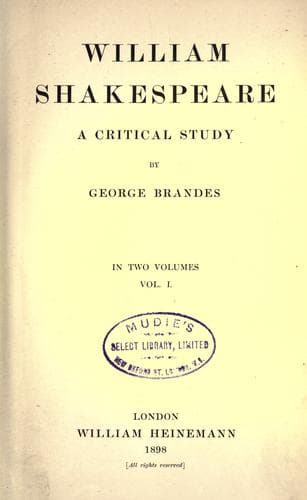
William Shakespeare: A Critical StudyBrandes, Georg
General
William Shakespeare: A Critical Study
Brandes, Georg
Shakespeare, William, 1564-1616 -- Criticism and interpretation
On the 19th February, Essex and Southampton were brought before a court
consisting of twenty-five peers and nine judges. Already, on the 17th,
Thomas Leigh, a captain in Essex's Irish army, for trying to gain
access to the palace on the 8th February, had been beheaded in the
Tower. Now that Essex's cause was irreparably lost, Bacon had no other
thought than to make himself useful to the party in power and prove his
devotion to the Queen. The purport of his first speech against Essex
was to prove that the plan of exciting an insurrection in the city,
which was in reality an inspiration of the moment, had been the result
of three months' deliberation. He represented as false and hypocritical
Essex's assurance that he was driven to action by dread of the
machinations of powerful enemies. He compared Essex to Cain, the first
murderer, who also sought excuses for his deed, and to Pisistratus,
who wounded himself and ran through the streets of Athens, crying that
an attempt had been made upon his life. The Earl of Essex, he said, in
reality had no enemies.
Essex rejoined that he could "call forth Mr. Bacon against Mr. Bacon."
Bacon, "being a daily courtier," had promised to plead his cause with
the Queen. He had with great address composed a letter to her, to be
signed by Essex. He had also written another letter in his brother
Anthony's name, and an answer to it from Essex, both of which he was
to show to the Queen; and in these "he laid down the grounds of my
discontent, and the reasons I pretend against mine enemies, pleading as
orderly for me as I could do myself."
This rejoinder told sensibly against Bacon, and drove him in his reply
to launch against his benefactor a new and much more malignant and
dangerous comparison. He likened him to a renowned contemporary, also
a nobleman and a rebel, the Duke of Guise: "It was not the company you
carried with you, but the assistance you hoped for in the City which
you trusted unto. The Duke of Guise thrust himself into the streets of
Paris on the day of the Barricados in his doublet and hose, attended
only with eight gentlemen, and found that help in the city which
(thanks be to God) you failed of here. And what followed? The King was
forced to put himself into a pilgrim's weeds, and in that disguise to
steal away to scape their fury."
In view of Essex's persistent denial that he had aspired to the throne
or sought to do the Queen any injury, this parallel was a terrible one
for him.
Both he and Southampton were found guilty and condemned to death.
Public-domain text, read in full here on John Shaqi.
Reviews
Reviews
No reviews yet
Be the first to share your thoughts on this work.
Elsewhere in the archive
Join the Discussion
Join the discussion
Sign in to leave a comment or review.
Sign InorCreate an account