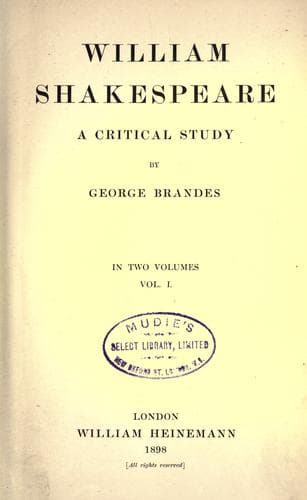
William Shakespeare: A Critical StudyBrandes, Georg
General
William Shakespeare: A Critical Study
Brandes, Georg
Shakespeare, William, 1564-1616 -- Criticism and interpretation
Elizabeth had first signed the death-warrant, and then recalled it. On
the 24th February she signed it a second time, and on the 25th February
1601, Essex's head was severed by three blows of the axe.
The populace could not be persuaded of their favourite's guilt. They
loathed his executioner, and detested those men who, like Bacon and
Raleigh, had, by their malice, contributed to his downfall.
In order to justify itself, the Government issued an official
_Declaration touching the Treasons of the late Earl of Essex and his
complices_, in the composition of which Bacon bore a large part. It
is very untrustworthy. James Spedding, indeed, one of Bacon's best
biographers, has tried to reconcile it with the facts; but he has
not succeeded in explaining away the damnatory circumstance that
everything is omitted which tended at the trial to establish Essex's
intention to use no violence, and to prove how entirely unpremeditated
was the attempt to raise an insurrection in the city. Where passages
of this nature occur in the records, all of which are preserved, we
find the letters _om_, (meaning, of course, "to be omitted") written
in the margin, sometimes in Bacon's hand, sometimes in that of the
Attorney-General, Coke.[1].
Bacon, with his brilliant intellectual equipment and his consciousness
of his great powers, is not to be set down as simply a bad man. But his
heart was cold, and he had no greatness of soul. He was absorbed, to
a quite unworthy degree, in the pursuit of worldly prosperity. Always
deeply in debt, he coveted above everything fine houses and gardens,
massive plate, great revenues, and, as essential preliminaries, high
offices and employments, titles and distinctions, which he might well
have left to men of meaner worth. He passed half his life in the
character of an office-seeker, met with one humiliating refusal after
another, and returned humble thanks for the gracious denial. Once
and once only, in his early days in Parliament, did he display some
independence and rectitude; but when he saw that it gave offence in the
highest places, he repented as bitterly as though he had been guilty
of a sin against all political morality, and besought her Majesty's
forgiveness in terms that might have befitted a detected thief. With
the like baseness and pusillanimity he now turned against Essex. He
had often cited the maxim, which even Cicero criticised in the _De
Amicitia_: "Love as if you should hereafter hate, and hate as if you
should hereafter love." He had never loved Essex otherwise. His excuse,
if there can be any, for seeking advancement at all costs, must be
found in the fact that he had the highest conception of his own value
to science, and thought that it would be to the honour and advantage of
learning that he, its high-priest, should be highly placed.
Public-domain text, read in full here on John Shaqi.
Reviews
Reviews
No reviews yet
Be the first to share your thoughts on this work.
Elsewhere in the archive
Join the Discussion
Join the discussion
Sign in to leave a comment or review.
Sign InorCreate an account