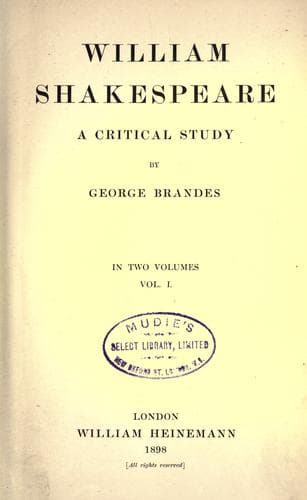
William Shakespeare: A Critical StudyBrandes, Georg
General
William Shakespeare: A Critical Study
Brandes, Georg
Shakespeare, William, 1564-1616 -- Criticism and interpretation
If we examine Essex's portrait, with its regular beauty, its air of
distinction and gentleness, the high forehead, the curly hair, and
the carefully combed long light beard, we can readily understand that
such a man, surrounded by a halo of adventurous renown, must become
the idol of the populace, and that the military incompetence which he
had twice displayed should not greatly affect the high esteem in which
the people held him. He was in reality as little of a statesman as of
a general; he was simply a free-speaking, passionate man, innocent of
diplomacy, a brave soldier without an idea of tactics. He misunderstood
his influence over Elizabeth, and did not realise that the Queen,
while she felt the charm of his personality, contemned his political
counsels. There was a good deal of the poet in his composition; he
wrote pretty sonnets, was a patron of writers no less than of fighters,
showed himself generous to profusion towards his friends and clients,
and found, perhaps, his sincerest and most convinced admirers among
the authors and poets of the day. Innumerable are the books which are
dedicated to him.
There is no doubt that after his melancholy death, a marked decline was
apparent in the Queen's courage and spirits. The legend, however, that
it was the fact of his execution which she took so much to heart, is
scarcely to be believed, and the story about Essex's ring, which was
conveyed to her too late, is unquestionably a fable. It is certain,
on the other hand--for the Duc de Biron, the envoy of Henri IV., had
no motive for telling a falsehood--that on the 12th September 1601,
after a conversation about Essex in which she jested over her departed
favourite, Elizabeth opened a box and took out of it Essex's skull,
which she showed to Biron. Ten months later, this favourite of the
French king--whose name Shakespeare had borrowed for the hero of his
first comedy--met with the very fate of Essex, and for a similar crime.
Bacon, no doubt, mourned Essex's disappearance even less than did the
Queen. After Elizabeth's death, however, when the friends of Essex
stood in the highest favour with the new King, he was shameless enough
to send a letter to Southampton (who, though not yet released from the
Tower, was already regarded as a power in the land), in which, after
having expressed his fear of being met with distrust, he concludes
thus: "It is as true as a thing that God knoweth, that this great
change hath wrought in me no other change towards your Lordship than
this, that I may safely be now that which I was truly before."
Public-domain text, read in full here on John Shaqi.
Reviews
Reviews
No reviews yet
Be the first to share your thoughts on this work.
Elsewhere in the archive
Join the Discussion
Join the discussion
Sign in to leave a comment or review.
Sign InorCreate an account