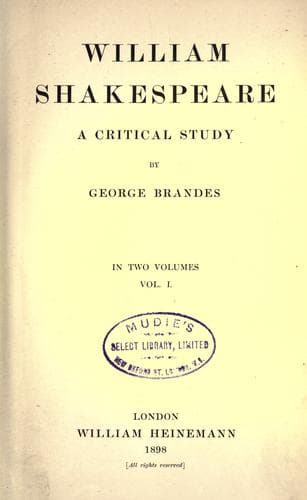
William Shakespeare: A Critical StudyBrandes, Georg
General
William Shakespeare: A Critical Study
Brandes, Georg
Shakespeare, William, 1564-1616 -- Criticism and interpretation
"Let this sad interim like the ocean be
Which parts the shores, where _two contracted new_
Come daily to the banks"--
we may confidently assign to the year 1598 the first contract of amity
between the poet and his friend. However, all this is by no means
conclusive. Shakespeare may have known Horace from other sources than
Meres, and the quotation from Ovid, together with the expressions used
by Meres, he certainly had encountered in Golding's translation of the
_Metamorphoses_, with which he was familiar.
The historical allusions in Sonnets c.-cxxvi., which form a continuous
poem, are not, indeed, by any means clear or easy to interpret; but
Sonnet civ. dates the whole group definitely enough, in the statement
that three years have elapsed since the first meeting of the friends:--
"Three winters cold
Have from the forests shook three summers' pride;
Three beauteous springs to yellow autumn turn'd
In process of the seasons have I seen;
Three April perfumes in three hot Junes burn'd,
Since first I saw you fresh, which yet are green."
Thus we must assign this important group to the year 1601; and this
being so, it must also appear probable that the line--
"The mortal moon hath her eclipse endured "--
alludes to the fact that Elizabeth (for whom, in the mode of the day,
the moon was the accepted symbol) had come unharmed through the dangers
of Essex's rebellion--the more so as the beautiful lines--
"Now with the drops of this most balmy time
My love looks fresh "--
show that the poem was written in the spring. It would be unreasonable
to infer from this allusion any ill-will on the poet's part towards
Essex and his comrades. Still less can we follow Tyler, when, by
the aid of a complex scaffolding of hypotheses built up, in German
rather than in English fashion, around Sonnets cxxiv. and cxxv., he
laboriously works up to the air-drawn conjecture that Shakespeare
is here expressing himself offensively towards his former patron
Southampton, now a prisoner in the Tower, and even that Southampton is
aimed at in the line about those "who have lived for crime." Equally
baseless, of course, is the corollary which would find in Sonnet cxxv.
Shakespeare's defence against an accusation of faithlessness towards
the man to whom he had written, seven years earlier, in the dedication
of _Lucrece_, "The love I dedicate Your Lordship is without end." Nor
It is absurd to construct a whole repulsive and fantastic romance on
the basis of a single obscure phrase.
Turning now from the poems to the person to whom they are believed to
have been addressed, this is what we learn of him:--
Public-domain text, read in full here on John Shaqi.
Reviews
Reviews
No reviews yet
Be the first to share your thoughts on this work.
Elsewhere in the archive
Join the Discussion
Join the discussion
Sign in to leave a comment or review.
Sign InorCreate an account