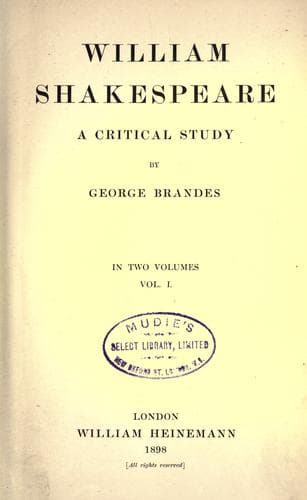
William Shakespeare: A Critical StudyBrandes, Georg
General
William Shakespeare: A Critical Study
Brandes, Georg
Shakespeare, William, 1564-1616 -- Criticism and interpretation
At what time, then, did the friendship begin? The date may be
determined with some confidence, even apart from the question as to
who the friend was. We know that Shakespeare must have written sonnets
before 1598, since Meres published in that year his often-quoted words
about the "sugred Sonnets"; but we cannot possibly determine which
Sonnets these were, or whether we possess them at all, since those
which passed from hand to hand "among his private friends" may very
possibly have disappeared. If they are included in our collection, we
may take them to be those in which we find frequent parallels to lines
in _Venus and Adonis_ and the early plays, though these coincidences
are by no means sufficient, as some of the German critics[1] would
have us believe, finally to establish the date of the Sonnets in which
they occur. However, they vary greatly in quality, and may have been
written at different periods. The first group, with its reiterated
appeal (seventeen times repeated) to the friend, to leave the world a
living copy of his beauty, is unquestionably the least valuable. The
personal feelings of the poet do not come much into play here, and
though these poems may have been addressed to William Herbert in 1598,
it is not impossible, taking into account the many analogies in thought
and mode of expression to be found in them and in _Venus and Adonis_
and _Romeo and Juliet_, that they were produced several years before,
and in this case, addressed to Southampton. Thomas Tyler believed he
had satisfactorily established the date of one important group by
showing that a passage in Meres's book had influenced the conception
and expression of one of Shakespeare's Sonnets. It cannot reasonably be
doubted that Shakespeare saw _Palladis Tamia_; the author perhaps sent
him a copy; and in any case he could not but have read with interest
the warm and sincere commendation there bestowed upon himself. Now
there occurs in Meres's book a passage in which, after quoting Ovid's
"Jamque opus exegi, quod nec Jovis ira, nec ignis,
Nec poterit ferrum, nec edax abolere vetustas,"
and Horace's
"Exegi momentum aere perennius,"
the critic goes on to apply these words to his contemporaries Sir
Philip Sidney, Spenser, Daniel, Drayton, Shakespeare, and Warner,
and then winds up with a Latin eulogy of the same writers, composed
by himself, partly in prose and partly in verse. But on reading
attentively Shakespeare's Sonnet lv., whose resemblance to the
well-known lines of Horace must have struck every reader, we find
several expressions from this passage in _Palladis Tamia_, and even
from the lines written by Meres himself, reappearing in it. The Sonnet
must thus have been written at earliest in the end of 1598--Meres's
book was entered in the Stationers' Register in September--and
possibly not till the beginning of 1599. Since, then, the following
Sonnet (lvi.), which must date from about the same time, speaks of the
friendship as newly formed--
Public-domain text, read in full here on John Shaqi.
Reviews
Reviews
No reviews yet
Be the first to share your thoughts on this work.
Elsewhere in the archive
Join the Discussion
Join the discussion
Sign in to leave a comment or review.
Sign InorCreate an account