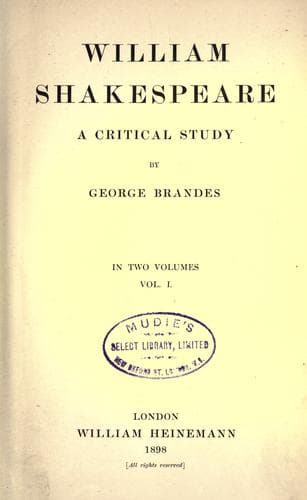
William Shakespeare: A Critical StudyBrandes, Georg
General
William Shakespeare: A Critical Study
Brandes, Georg
Shakespeare, William, 1564-1616 -- Criticism and interpretation
On January 19, 1601, his father's death made William Herbert Earl
of Pembroke. Very soon afterwards (the matter is mentioned in a
letter from Robert Cecil so early as February 5) he got into deep
disgrace over a love affair--evidently that which forms the subject
of Shakespeare's Sonnets. He had for some time carried on a secret
intrigue with the aforesaid Mary Fitton, a maid-of-honour who stood
high in the Queen's good graces; and the secret now came to light.
"Mistress Fitton," writes Cecil, "is proved with child, and the Earl
of Pembroke, being examined, confesseth a fact, but utterly renounceth
all marriage. I fear they will both dwell in the Tower awhile, for the
Queen hath vowed to send them thither." In another contemporary letter
it is stated that "in that tyme when that Mres Fytton was in great
fauor ... and duringe the time yt the Earle of Pembrooke fauord her,
she would put off her head tire and tucke vp her clothes and take a
large white cloake, and march as though she had bene a man to meete the
said Earle out of the Courte."
Mary Fitton gave birth to a still-born son; Pembroke lay for a month in
the Fleet Prison, and was banished from Court. He shortly afterwards
applied through Cecil for leave to travel abroad. The Queen's
displeasure, he says, is "a hell" to him; he hopes the Queen will not
carry her resentment so far as to bind him to the country which has
now become "hateful to him of all others." The permission to travel
seems to have been given and then revoked. In the middle of June he
writes that imploring letter to Cecil in which the reference to "her
whose Incomparable beauty was the onely sonne of my little world," was
designed to touch Elizabeth's hard heart; for Pembroke, it is plain,
had now realised that what had offended her Majesty was not so much his
intrigue with Mary Fitton as the fact of his having overlooked her own
much higher perfections. But the compliments came too late. Elizabeth,
as we have already seen in the case of Essex, knew how to make the
objects of her resentment suffer in that most sensitive point--the
pocket. The "patent of the Forest of Dean," which had been held by the
late Lord Pembroke, expired with him, and the son expected, according
to use and wont, to have it renewed in his favour; but it was assigned
to Pembroke's rival, Sir Edward Winter, and not until seven years
later, under James, did Pembroke recover it.
Pembroke continued in disgrace, his renewed applications for permission
to travel were persistently refused, and he was ordered to regard
himself as banished from Court, and to "keep house in the country." It
is this overshadowing of Pembroke's fortunes in 1601 which explains the
temporary breaking-off of his relations with Shakespeare in London,
indicated by the "Envoy" with which Sonnet cxxvi. ends the series
addressed to the Friend.
Public-domain text, read in full here on John Shaqi.
Reviews
Reviews
No reviews yet
Be the first to share your thoughts on this work.
Elsewhere in the archive
Join the Discussion
Join the discussion
Sign in to leave a comment or review.
Sign InorCreate an account