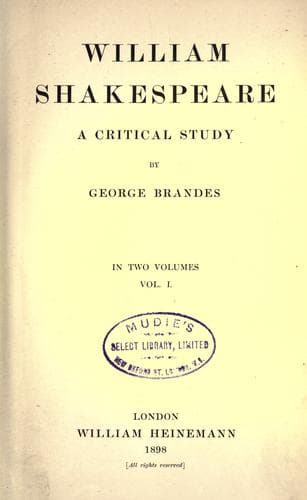
William Shakespeare: A Critical StudyBrandes, Georg
General
William Shakespeare: A Critical Study
Brandes, Georg
Shakespeare, William, 1564-1616 -- Criticism and interpretation
The close and affectionate relation between them was no doubt revived
under James. This appears clearly enough from the Dedication of the
First Folio. Let us now cast a rapid glance over the remainder of
Pembroke's career.
His father's death placed him in possession of a large fortune,
but the irregularity of his life left him seldom free from money
embarrassments. In 1604 he married Lady Mary, the seventh daughter of
Lord Talbot, and the marriage was celebrated with a tournament. His
wife brought him a large property, but it was thought at the time that
he paid very dear for it in having to take her into the bargain. The
marriage was far from happy.
Pembroke shared the love of literature which had distinguished his
mother and his uncle, Sir Philip Sidney. According to Aubrey, he
was "the greatest Mæcenas to learned men of any peer of his time or
since." Among his "learned" friends were the poets Donne, and Daniel,
and Massinger, who was the son of his father's steward. Ben Jonson
composed a eulogistic epigram in his honour, as well he might, for
every New Year Pembroke sent Ben £20 to buy books with. Inigo Jones is
said to have visited Italy at his expense, and was frequently employed
by him. Davison's _Poetical Rhapsody_ and numerous other books are
dedicated to him. Chapman, who was among his intimates, inscribed a
sonnet to him at the close of his translation of the _Iliad_. This fact
is of particular interest to us, because Chapman (as Professor Minto
succeeded in establishing) is clearly the rival poet who paid court to
Pembroke, won his goodwill and admiration, and thereby aroused jealousy
and melancholy self-criticism in Shakespeare's breast, as we read in
Sonnets lxxviii.-lxxxvi.[2].
It is especially on Sonnet lxxxvi. that Minto bases his identification
of the rival poet with Chapman. The very opening line, referring
to the "proud full sail of his great verse," suggests at once the
fourteen-syllable measure in which Chapman translated the _Iliad_.
Chapman was full of a passionate enthusiasm for the art of poetry,
which he lost no opportunity of glorifying; and he laid claim to
supernatural inspiration. In the Dedication to his poem _The Shadow of
the Night_ (1594), he speaks with severe contempt of the presumption of
those who "think Skill so mightily pierced with their loves that she
should prostitutely show them her secrets, when she will scarcely be
looked upon by others but with invocation, fasting, watching--yea, not
without having drops of their souls, _like a heavenly familiar. _Hence
Shakespeare's lines--
"Was it his spirit, by spirits taught to writ
Above a mortal pitch that struck me dead?"
and the expression--
"He, nor that affable familiar ghost
Which nightly gulls him with intelligence."
Public-domain text, read in full here on John Shaqi.
Reviews
Reviews
No reviews yet
Be the first to share your thoughts on this work.
Elsewhere in the archive
Join the Discussion
Join the discussion
Sign in to leave a comment or review.
Sign InorCreate an account