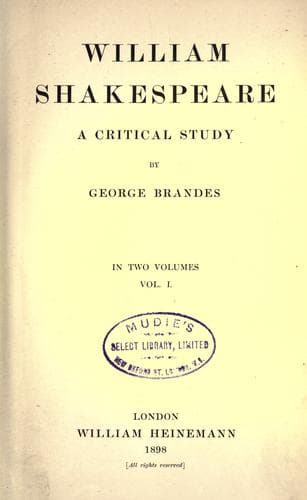
William Shakespeare: A Critical StudyBrandes, Georg
General
William Shakespeare: A Critical Study
Brandes, Georg
Shakespeare, William, 1564-1616 -- Criticism and interpretation
From Mary Fitton herself there is only a brief note contained in the
collection, but her name is often mentioned in the letters. They prove,
that at the beginning of her career as maid-of-honour to the Queen, she
had an admirer in the elderly court-functionary, Sir William Knollys,
inspector of the household, who later, under King James, became a very
potent personality as Lord Knollys; and it was evidently arranged
between them that they would marry as soon as Sir William should become
a widower. Their relations were not severed until the Pembroke scandal
came out. Sir William married another lady after the death of his
wife. This relation appeared to support the belief that Mary Fitton
was Shakespeare's lady, as far as it gave a clue to the expression
_thy bed vow broke_, and in so far as Knollys' Christian name William
seemed to explain the two first lines in Sonnet cxxxv.: You have your
will (or William) and William (or will) a second time and William (or
will) into the bargain. It had long been admitted that the two last
of these _Wills_ referred to Pembroke and Shakespeare. And it was
suggested that a third Will was hidden in the first. In 1881 Dowden
wrote: "As we know that the lady had a husband, it may be possible
that he too bore the name of William." As against the unmistakable
evidence of the portraits, however, it is impossible to attribute any
weight to this circumstance. Moreover, the name of Shakespeare is never
mentioned in the recently-published papers of the Fitton family. Of
course the silence in itself is not conclusive. Mary Fitton may have
known Shakespeare intimately without her relatives being aware of the
fact. Besides, we know, from the dedication, which the clown of the
Shakespearian troupe, the well known William Kemp, in 1600, addressed
to her in his little book "Nine Daies Wonder," that she had certain
relations with the company. This dedication runs as follows: _Mistress
Anne (supposed to be Mary) Fitton, Mayde of Honour of the most sacred
Mayde Royal Queene Elisabeth._ But I confess, that Mary's grey eyes
decide the matter for me.
However, even if it be unreasonable to identify Mary Fitton with the
Dark Lady of the Sonnets, after the publication of the Fitton family
papers, this does not exclude the possibility that Pembroke may have
been Shakespeare's rival. If Essex, as above mentioned, was obliged to
acknowledge that he had had intrigues with four of the ladies of the
court at the same time, Pembroke may well have had intimate relations
with two of them at Once.
The Dark Lady must have been a woman in the extremest sense of the
word, a daughter of Eve, alluring, ensnaring, greedy of conquest,
mendacious and faithless, born to deal out rapture and torment with
both hands, the very woman to set in vibration every chord in a poet's
soul.
Public-domain text, read in full here on John Shaqi.
Reviews
Reviews
No reviews yet
Be the first to share your thoughts on this work.
Elsewhere in the archive
Join the Discussion
Join the discussion
Sign in to leave a comment or review.
Sign InorCreate an account