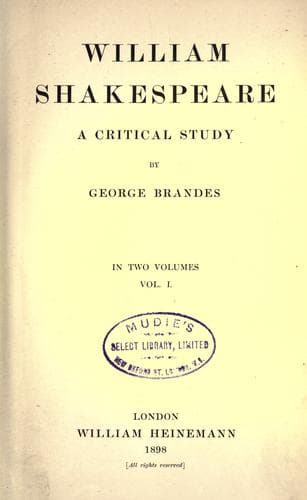
William Shakespeare: A Critical StudyBrandes, Georg
General
William Shakespeare: A Critical Study
Brandes, Georg
Shakespeare, William, 1564-1616 -- Criticism and interpretation
It was thought surprising that in Sonnet clii., in which Shakespeare
calls himself forsworn because he loves his lady although married to
another, he also states expressly that she too is married, calling her
"twice forsworn," since she has not only broken her "bed-vow," but
broken her "new faith" to Shakespeare himself. It seemed difficult to
reconcile this with the fact that Mrs. Fitton ("Mistress" in those days
being applicable to unmarried no less than to married women) was always
called by her father's name. She was married in 1607 to a certain
William Polwheele, with whom she appears to have had a love-intrigue
before the wedding. After the death of her husband she was married a
second time to John Lougher.
However, it must now be pointed out that a work, published in 1897,
which for the first time gave a trustworthy account of Mary Fitton's
life, has rendered it excessively improbable that she should be
identical with the Dark Lady of the Sonnets. The title of the work is:
_Gossip from a Muniment-Room, being Passages in the lives of Anne and
Mary Fitton_, 1574-1618; it is published by Lady Newdigate-Newdegate,
who is married to a descendant of the elder sister, Anne Fitton,
and it contains many interesting letters to this lady, with other
communications from the family-archives. Here it is proved--in spite of
Tyler's attempted contradiction--that the two well-preserved portraits
of Mary Fitton at Arbury show that she was not dark at all, but had a
light complexion, brown hair, and grey eyes.
Public-domain text, read in full here on John Shaqi.
Reviews
Reviews
No reviews yet
Be the first to share your thoughts on this work.
Elsewhere in the archive
Join the Discussion
Join the discussion
Sign in to leave a comment or review.
Sign InorCreate an account