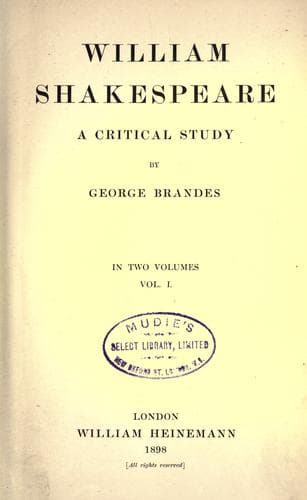
William Shakespeare: A Critical StudyBrandes, Georg
General
William Shakespeare: A Critical Study
Brandes, Georg
Shakespeare, William, 1564-1616 -- Criticism and interpretation
The distance from this to the dedication of the Sonnets
is great.
What Sidney Lee attempts to prove by his researches and conjectures
is, that the man, who figures in the Sonnets as the protector of the
poet, was Southampton, and not Pembroke. The name of the youth is not
of the first importance, nor does it signify greatly whether the woman
celebrated and attacked in the Sonnets bore the name of Mary Fitton
or another. However, the main point is, that in common with a number
of previous authors, who have thoroughly studied the contemporaneous
literature of Europe, and more especially the sonnet-poetry of Italy,
France and England, such as Delius and Elze in Germany, and Henrik
Schück in Sweden, Lee, relying on the numerous traits that these poems
share with other sonnet-cycles of their period, stamps the whole
argument of the text as fiction, and denies their autobiographical
character. Scarcely any writer before him has so boldly endeavoured to
limit Shakespeare's originality in the domain of sonnet-poetry.
In the first place Lee points out, that the whole body of sixteenth-century
sonnets was so dependent firstly on Petrarch, then on such French
writers as Ronsard, du Bellay and Desportes, that even the finest of
them, the sonnets of Spenser, Sidney, Watson, Lodge, Drayton and Daniel
may be characterised as imitative studies, if not simply as a mosaic
of plagiarisms. Hereupon he tries to show Shakespeare's dependence on
his predecessors. Shakespeare picked up, without scruple, ideas and
expressions from the sonnets published by Daniel, Drayton, Watson,
Barnabe Barnes, Constable and Sidney; he did this as deliberately and
imperturbably as in his comedies he manipulated dramas and novels by
contemporary and older poets. To Drayton especially is Shakespeare
indebted. As all the Englishmen imitated the Frenchmen, Shakespeare has
a false air of having been directly influenced by Ronsard, de Baif and
Desportes, though he scarcely knew these poets in their own language.
The Danish translator of the Sonnets, Adolf Hansen, had already pointed
out numerous impersonal traits. Some of the poorer Sonnets with their
forced and complicated metaphors so obviously bear the impress of
the spirit of the age, that it is quite impossible to regard them as
characteristic of Shakespeare, and some few Sonnets are such complete
imitations, that they cannot be accepted as confessions. Sonnets xviii.
and xix. work out the same idea as Daniel's Delia, and Sonnets lv.
and lxxxi. treat the very same subject as the sixty-ninth Sonnet in
Spenser's _Amoretti_. Finally the story of the friends, one of whom
deprives the other of his mistress, is to be found in Lyly's _Euphues_.
Public-domain text, read in full here on John Shaqi.
Reviews
Reviews
No reviews yet
Be the first to share your thoughts on this work.
Elsewhere in the archive
Join the Discussion
Join the discussion
Sign in to leave a comment or review.
Sign InorCreate an account