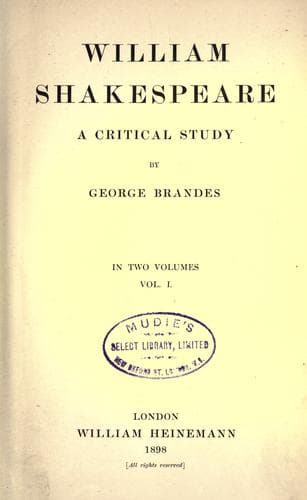
William Shakespeare: A Critical StudyBrandes, Georg
General
William Shakespeare: A Critical Study
Brandes, Georg
Shakespeare, William, 1564-1616 -- Criticism and interpretation
Sidney Lee maintains that when in Sonnets xxiv. and cxxii. Shakespeare
propounds that the image of his friend is engraved in the depths of his
heart, or that his brain is a better memorandum-book, as to the friend,
than the book with which the latter has presented him, he is merely
struggling with conceits of Ronsard's. When in Sonnets xliv, and xlv.
he speaks about man as compounded of the elements, earth, air, fire and
water, he appropriates motives from Spenser and Barnes. Sonnets xlvi.
and xlvii., on the debate of the eye and the heart, are written in
terms borrowed from the twentieth Sonnet in Watson's _Tears of Fancy_.
Where he proclaims his assurance of the immortality of his verse, and
the consequent eternity of his friend's fame, he does not speak from
conviction, he only treats a motive, which, following the example of
Pindar, Horace and Ovid, the Frenchmen Desportes and Ronsard, and after
them such English sonneteers as Spenser, Drayton and Daniel had played
upon. Not even when he writes that his lady is beautiful, though dark,
and consequently unlovely, is he original; for Sidney had already used
a similar phrase. And when he changes his mind, and in the dark eyes
and dark complexion of his lady professes to read the blackness of
her soul, he is even less original, for at that period the sonnet of
invective was the standard variant of the sonnet of amorous eulogy.
Nothing is more common than to find the sonneteer grossly abusing his
mistress. Ronsard called his a tigress, a murderess, a Medusa; Barnabe
Barnes describes his as a tyrant, a Gorgon, a rock; the transition from
tenderness to reproach was so frequent, that it was even parodied by
Gabriel Harvey. Following many other critics Sidney Lee finally points
out that no weight can be attached to the fact, that in Sonnets xxii.,
lxii., lxxiii., and cxxxviii., Shakespeare speaks of himself as old,
for this, too, was a standing conceit of the sonnet-poets of that time.
Daniel in _Delia_ (23) when he was only twenty-nine speaks as if his
life were finished. Richard Barnfield, only twenty years old, invites
the boy Ganymedes to contemplate his silver hair, his wrinkled skin,
the deep furrows of his face, all this in imitation of Petrarch.
Lee admits, however, that the group of Sonnets, most interesting to the
reader, the most mature as to ideas and style, cannot be considered to
date from the poet's thirtieth year; he even thinks that Shakespeare
continued to write Sonnets until 1603, and propounds--regardless of the
wording of the poem--that Sonnet cvii. was written in that year, on the
occasion of the death of Queen Elizabeth. That the word "moon" here
means Elizabeth is obvious. But that the expression
"The mortal moon hath her eclipse endured"
Public-domain text, read in full here on John Shaqi.
Reviews
Reviews
No reviews yet
Be the first to share your thoughts on this work.
Elsewhere in the archive
Join the Discussion
Join the discussion
Sign in to leave a comment or review.
Sign InorCreate an account