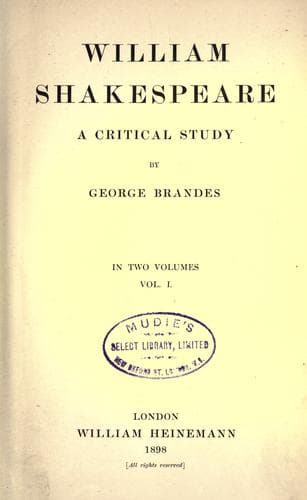
William Shakespeare: A Critical StudyBrandes, Georg
General
William Shakespeare: A Critical Study
Brandes, Georg
Shakespeare, William, 1564-1616 -- Criticism and interpretation
The great modern poets, whose lives lie open before us, have betrayed
to us how fancy springs out of impressions of real life, transforming
them and making them unrecognisable by its mysterious workings. In
several cases we are able to discern the dispersed elements, which in
due time crystallise in the poem. Discerning criticism has opened our
eyes to the intermixture of these elements in the magic caldron of
fancy, while inferior criticism goes astray in a trivial search after
possible models. In spite of German scholars and their exertions,
we know nothing about whom Goethe had in his mind when he painted
Clärchen, nor is this fact of any importance; but this is certain, that
the whole poetical life-work of Goethe is founded upon experience. When
Max Klinger one evening returned home from having seen a performance of
Goethe's _Faust_, he said: What most impressed me was that it was the
life of Goethe.
As, knowing the life and experiences of the great modern poet, we are
now generally able to trace how these are worked upon and transformed
in his works, it is reasonable to suppose that in olden times poets
were moved by the same causes, and acted in the same way, at least
those of them who have been efficient. When we know of the adventures
and emotions of the modern poet, and are able to trace them in the
production of his free fancy; when it is possible, where they are
unknown to us, to evolve the hidden personality of the poet, and--as
every capable critic has experienced--to have our conjectures finally
borne out by facts revealed by the contemporary author, then we cannot
feel it to be impossible, that in the case of an older poet, we might
also be successful in determining when he speaks earnestly from his
heart, and in tracing his feelings and experiences through his works,
especially when these are lyrical, and their mode of expression
passionate and emotional.
Any one who holds fast to the by no means fantastic theory, that there
is a certain connection between the life and the works of Shakespeare,
will be but little moved by successive attempts to deny the Sonnets any
autobiographical value, because of the conventional traits and frequent
imitations to be pointed out in them.
The modern reader who takes up the Sonnets with no special knowledge of
the Renaissance, its tone of feeling, its relation to Greek antiquity,
its conventions and its poetic style, finds nothing in them more
surprising than the language of love in which the poet addresses his
young friend, the positively erotic passion for a masculine personality
which here finds utterance. The friend is currently addressed as "my
love." Sometimes it is stated in so many words that in the eyes of his
admirer the friend combines the charms of man and woman; for instance,
in Sonnet xx.:--
"A woman's face, with Nature's own hand painted,
Hast thou, the master mistress of my passion."
Public-domain text, read in full here on John Shaqi.
Reviews
Reviews
No reviews yet
Be the first to share your thoughts on this work.
Elsewhere in the archive
Join the Discussion
Join the discussion
Sign in to leave a comment or review.
Sign InorCreate an account