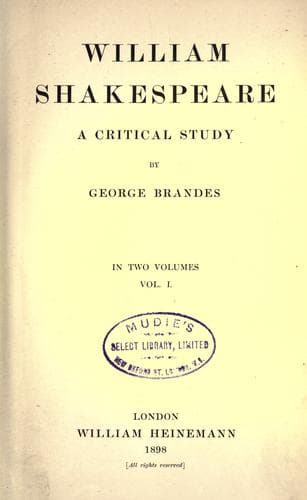
William Shakespeare: A Critical StudyBrandes, Georg
General
William Shakespeare: A Critical Study
Brandes, Georg
Shakespeare, William, 1564-1616 -- Criticism and interpretation
can mean the final eclipse of the moon is incredible. That the moon
has passed through her eclipse, means, I take it, that she is shining
brightly again, and thus the interpretation put forth above, of a hint
at the frustrated conspiracy of Essex, is far more reasonable. But then
this Sonnet, as well as those kindred to it in spirit and tone, point,
not to the year 1603, but to 1601.
Yet here details are of minor importance. We take our stand on a
fundamental conception of poetic production. All art, even that of the
greater artists, begins with imitation; no poet avoids influences,
and up to the present time no poet has hesitated to appropriate from
predecessors all that might be of use to him. Even nowadays, when the
appreciation of the duty of originality is so infinitely stronger than
in the sixteenth, seventeenth, and eighteenth centuries, it is easy
to point out appropriations of foreign thoughts and turns of phrase
among excellent poets, and it would be possible to enumerate a great
variety of common traits among the lyrical poets of Europe. The range
of subjects fit for lyrical poetry is not so very great, to be sure.
As men, lyrists have after all many emotions and conditions in common.
In the mode of expression alone--especially when ideas have to be
expressed in an identical form of fourteen lines--is it possible for
the poet to manifest his true originality.
No intelligent critic would think of looking to lyrical poems as to
biographical sources, in the rough meaning of the term. The poetical
is rarely identical with the personal ego. But on the other hand it
cannot be too strongly insisted upon that books (I mean great, inspired
books, such as are read for hundreds of years) are never engendered
by other books, but by life. Nobody, who has a drop of artist's blood
in his veins, can imagine that a poet of the rank of Shakespeare
can have written sonnets by the score only as exercises or metrical
experiments, without any bearing on his life, its passions and its
crises. The formula for good epic poetry is surely this: that it must
always be founded on real life, even if rarely or never an exact copy
of it. Lyrical poetry, in which the poet speaks in his own name, and
especially of himself, must necessarily, if first-rate, be rooted in
what the poet has felt so strongly that it has made him break into song.
The learned critics of Shakespeare's Sonnets regard them merely as
metrical _tours de force_, penned in cold blood on subjects prescribed
by fashion and convention. They look upon fancy as upon a spider, which
spins chimera in all sorts of typical and artificial figures out of
itself. It seems more natural to look upon it as a plant, extracting
nourishment from the only soil in which it could thrive, namely, the
observations and experiences of the poet.
Public-domain text, read in full here on John Shaqi.
Reviews
Reviews
No reviews yet
Be the first to share your thoughts on this work.
Elsewhere in the archive
Join the Discussion
Join the discussion
Sign in to leave a comment or review.
Sign InorCreate an account