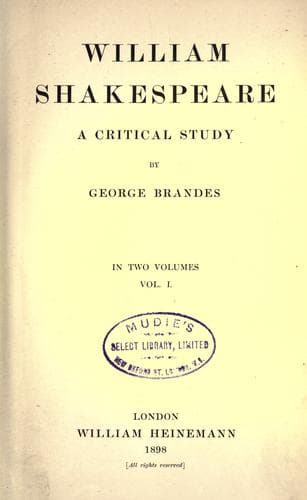
William Shakespeare: A Critical StudyBrandes, Georg
General
William Shakespeare: A Critical Study
Brandes, Georg
Shakespeare, William, 1564-1616 -- Criticism and interpretation
"If only chains and bands can make me blest,
No marvel if alone and bare I go
An armed knight's captive and slave confessed."
(_J. A. Symonds_.)
In other sonnets the tone is no less passionate than Shakespeare's
--take, for example, the twenty-second:--
"More tenderly perchance than is my due,
Your spirit sees into my heart, where rise
The flames of holy worship, nor denies
The grace reserved for those who humbly sue.
Oh blessed day when you at last are mine!
Let time stand still, and let noon's chariot stay;
Fixed be that moment on the dial of heaven!
That I may clasp and keep, by grace divine--
Clasp in these yearning arms and keep for aye
My heart's loved lord to me desertless given."[5]
(_J. A. Symonds_.)
In comparison with Cavalieri, Michael Angelo could with justice call
himself old. Some critics, on the other hand, have seen in the fact
that Shakespeare was not really old at the time when the Sonnets were
written, a proof of their conventional and unreal character. But this
is to overlook the relativity of the term. As compared with a youth of
eighteen, Shakespeare was in effect old, with his sixteen additional
years and all his experience of life. And if we are right in assigning
Sonnets lxiii. and lxxiii. to the year 1600 or 1601, Shakespeare had
then reached the age of thirty-seven, an age at which (among his
contemporaries) Drayton in his _Idea_ dwells quite in the same spirit
upon the wrinkles of age in his face, and at which, as Tyler has very
aptly pointed out, Byron in his swan-song uses expressions about
himself which might have been copied from Shakespeare's seventy-third
Sonnet. Shakespeare says:--
"That time of year thou mayst in me behold
When _yellow leaves_, or none, or few, do hang
Upon those boughs which shake against the cold
Bare ruin'd choirs, where late the sweet birds sang."
Byron thus expresses himself:--
"My days are in _the yellow leaf_,[6]
The flowers and fruits of love are gone,
The worm, the canker and the grief
Are mine alone."
In Shakespeare we read:--
"In me thou seest _the glowing of such fire_
That on the ashes of his youth doth lie
As the _death-bed_ whereon it must expire,
Consum'd with that which it was nourish'd by."
Byron's words are:--
"_The fire that on my bosom preys_
Is lone as some volcanic isle;
No torch is kindled at its blaze--
_A funeral pile_"
Thus both poets liken themselves, at this comparatively early age, to
the wintry woods with their yellowing leaves, and without blossom,
fruit, or the song of birds; and both compare the fire which still
glows in their soul to a solitary flame which finds no nourishment from
without. The ashes of my youth become its death-bed, says Shakespeare.
They are a funeral pile, says Byron.
Public-domain text, read in full here on John Shaqi.
Reviews
Reviews
No reviews yet
Be the first to share your thoughts on this work.
Elsewhere in the archive
Join the Discussion
Join the discussion
Sign in to leave a comment or review.
Sign InorCreate an account