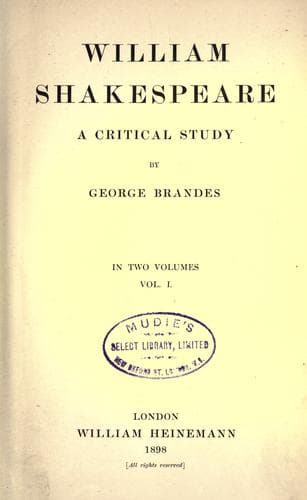
William Shakespeare: A Critical StudyBrandes, Georg
General
William Shakespeare: A Critical Study
Brandes, Georg
Shakespeare, William, 1564-1616 -- Criticism and interpretation
Nor is it possible to conclude, as Schück does, from the conventional
style of the first seventeen Sonnets--for instance, from their almost
verbal identity with a passage in Sidney's _Arcadia_--that they are
quite devoid of relation to the poet's own life.
In short, the elements of temporary fashion and convention which appear
in the Sonnets in no way prove that they were not genuine expressions
of the poet's actual feelings.
They lay bare to us a side of his character which does not appear in
the plays. We see in him an emotional nature with a passionate bent
towards self-surrender in love and idolatry, and with a corresponding,
though less excessive, yearning to be loved.
We learn from the Sonnets to what a degree Shakespeare was oppressed
and tormented by his sense of the contempt in which the actor's calling
was held. The scorn of ancient Rome for the mountebank, the horror of
ancient Judea for whoever disguised himself in the garments of the
other sex, and finally the age-old hatred of Christianity for theatres
and all the temptations that follow in their train--all these habits
of thought had been handed down from generation to generation, and, as
Puritanism grew in strength and gained the upper hand, had begotten a
contemptuous tone of public opinion under which so sensitive a nature
as Shakespeare's could not but suffer keenly. He was not regarded as
a poet who now and then acted, but as an actor who now and then wrote
plays. It was a pain to him to feel that he belonged to a caste which
had no civic status. Hence his complaint, in Sonnet xxix., of being "in
disgrace with fortune and men's eyes." Hence, in Sonnet xxxvi., his
assurance to his friend that he will not obtrude on others the fact of
their friendship:--
"I may not evermore acknowledge thee,
Lest my bewailèd guilt should do thee shame:
Nor thou with public kindness honour me,
Unless thou take that honour from thy name:
But do not so; I love thee in such sort,
As, thou being mine, mine is thy good report."
The bitter complaint in Sonnet lxxii. seems rather to refer to the
writer's situation as a dramatist:--
"For I am shamed by that which I bring forth,
And so should you, to love things nothing worth."
The melancholy which fills Sonnet cx. is occasioned by the writer's
profession and his nature as a poet and artist:--
"Alas! 'tis true, I have gone here and there,
And made myself a motley to the view;
Gor'd mine own thoughts, sold cheap what is most dear,
Made old offences of affections new:
Most true it is, that I have look'd on truth
Askance and strangely; but, by all above,
These blenches gave my heart another youth,
And worse essays prov'd thee my best of love."
Hence, finally, his reproach to Fortune, in Sonnet cxi., that she did
not "better for his life provide Than public means which public manners
breeds":--
Public-domain text, read in full here on John Shaqi.
Reviews
Reviews
No reviews yet
Be the first to share your thoughts on this work.
Elsewhere in the archive
Join the Discussion
Join the discussion
Sign in to leave a comment or review.
Sign InorCreate an account