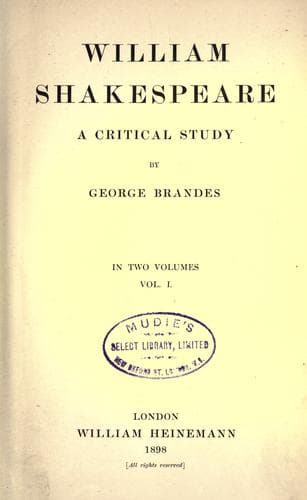
William Shakespeare: A Critical StudyBrandes, Georg
General
William Shakespeare: A Critical Study
Brandes, Georg
Shakespeare, William, 1564-1616 -- Criticism and interpretation
The details of this scandal are unknown to us. We can only conclude
that it referred to Shakespeare's alleged relation to some woman, or
implication in some amorous adventure. In discussing this point, Tyler
has aptly cited two passages in contemporary writings, though of course
without absolutely proving that they have any bearing on the matter.
The first is the above-quoted anecdote in John Manningham's Diary for
March 13, 1601 (New Style, 1602), as to Shakespeare's forestalling
Burbadge in the graces of a citizen's wife, and announcing himself as
"William the Conqueror "--an anecdote which seems to have been widely
current at the time, and no doubt arose from more or less recent
events. The second passage occurs in _The Returne from Pernassus_,
dating from December 1601, in which (iv. 3) Burbadge and Kemp are
introduced, and these words are placed in the mouth of Kemp: "O that
_Ben Ionson_ is a pestilent fellow, he brought vp _Horace_ giuing the
Poets a pill, but our fellow _Shakespeare_ hath giuen him a purge
that made him beray his credit." The allusion is evidently to the
feud between Ben Jonson on the one hand and Marston and Dekker on the
other, which culminated in 1601 with the appearance of Ben Jonson's
_Poetaster_, in which Horace serves as the poet's mouthpiece. Dekker
and Marston retorted in the same year with _Satiromastix, or the
Untrussing of the Humorous Poet_. As Shakespeare took no direct part
in this quarrel, we can only conjecture what is meant by the above
allusion. Mr. Richard Simpson has suggested that King William Rufus, in
whose reign the action of _Satiromastix_ takes place, and who "presides
over the untrussing of the humorous poet," may be intended for William
Shakespeare. Rufus, in the play, is by no means a model of chastity,
and carries off Walter Terrill's bride very much as "William the
Conqueror" in Manningham's anecdote carries off "Richard the Third's"
mistress. Simpson thinks it probable that the spectators would have
little difficulty in recognising the William the Conqueror of the
anecdote in the William Rufus of the play, whose nickname, indeed,
might be taken as referring to Shakespeare's complexion. If we accept
this interpretation, we find in _Satiromastix_ a further proof of the
notoriety of the anecdote. Whether it be this scandal or another of the
same kind to which the Sonnets refer, Shakespeare seems to have taken
greatly to heart the besmirching of his name.
It remains that we should glance at the form of the Sonnets and say a
word as to their poetic value.
As regards the form, the first and most obvious remark is that, in
spite of their name, these poems are not in reality sonnets at all, and
have, indeed, nothing in common with the sonnet except their fourteen
lines. In the structure of his so-called Sonnets Shakespeare simply
followed the tradition and convention of his country.
Public-domain text, read in full here on John Shaqi.
Reviews
Reviews
No reviews yet
Be the first to share your thoughts on this work.
Elsewhere in the archive
Join the Discussion
Join the discussion
Sign in to leave a comment or review.
Sign InorCreate an account