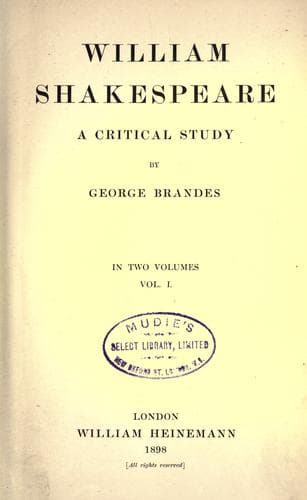
William Shakespeare: A Critical StudyBrandes, Georg
General
William Shakespeare: A Critical Study
Brandes, Georg
Shakespeare, William, 1564-1616 -- Criticism and interpretation
Sir Thomas Wyatt, the leading figure in the earlier English school of
lyrists, travelled in Italy in the year 1527, familiarised himself with
the forms and style of Italian poetry, and introduced the sonnet into
English literature. A somewhat younger poet, Henry, Earl of Surrey,
soon followed in his footsteps; he, too, travelled in Italy, and
cultivated the same poetic models. Not until after the death of both
poets were their sonnets published in the collection known as _Tottel's
Miscellany_ (1557). Neither of the poets succeeded in keeping to the
Petrarchan model--an octave and a sestett. Wyatt, it is true, usually
preserves the octave, but breaks up the sestett and finishes with a
couplet. Surrey departs still more widely from his model's strict and
difficult form: his "Sonnet" consists, like Shakespeare's after him,
of three quatrains and a couplet, the rhymes of which are in nowise
interwoven. Sidney, again, preserved the octave, but broke up the
sestett. Spenser attempted a new rhyme-scheme, interweaving the second
and third quatrain, but keeping to the final couplet. Daniel, who is
Shakespeare's immediate predecessor and master, returns to Surrey's
really formless form. The chief defect in Shakespeare's Sonnets as a
metrical whole consists in the appended couplet, which hardly ever
keeps up to the level of the beginning, hardly ever presents any
picture to the eye, but is, as a rule, merely reflective, and often
brings the burst of feeling which animates the poem to a feeble, or at
any rate more rhetorical than poetic, issue.
In actual poetic value the Sonnets are extremely uneven. The first
group as we have already pointed out (p. 270) stands lowest in the
scale, necessarily expressing but little of the poet's personal feeling.
The last two Sonnets in the collection (cliii. and cliv.), dealing
with a conventional theme borrowed from the antique, are likewise
entirely impersonal. W. Hertzberg, having been put on the track by
Herr von Friesen, in 1878 discovered the Greek original of these two
Sonnets in the ninth book of the Palatine Anthology.[9]. The poem
which Shakespeare has adapted, and in Sonnet cliv. almost translated,
was written by the Byzantine scholar Marianus, probably in the fifth
century after Christ; it was published in Latin, among other epigrams,
at Basle in 1529, was retranslated several times before the end of the
sixteenth century, and must have become known to Shakespeare in one or
other of these different forms.
Next in order stand the Sonnets of merely conventional inspiration,
those in which the eye and heart go to law with each other, or in
which the poet plays upon his own name and his friend's. These cannot
possibly claim any high poetic value.
Public-domain text, read in full here on John Shaqi.
Reviews
Reviews
No reviews yet
Be the first to share your thoughts on this work.
Elsewhere in the archive
Join the Discussion
Join the discussion
Sign in to leave a comment or review.
Sign InorCreate an account