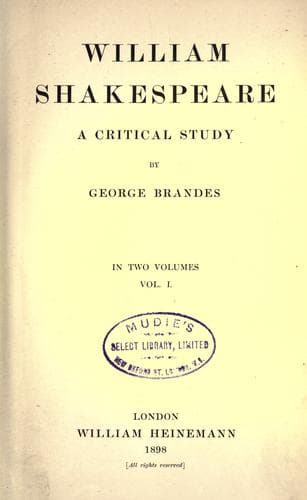
William Shakespeare: A Critical StudyBrandes, Georg
General
William Shakespeare: A Critical Study
Brandes, Georg
Shakespeare, William, 1564-1616 -- Criticism and interpretation
His method of using this material differs considerably from his
treatment of his other authorities. From a chronicler like Holinshed
he, as a rule, takes nothing but the course of events, the outline
of the leading personages and such anecdotes as suit his purpose.
From novelists like Bandello or Cinthio he takes the main lines of
the action, but relies almost entirely on his own invention for the
characters and the dialogue. From the earlier plays, which he adapts
or re-casts, such as _The Taming of a Shrew, King John, The Famous
Victories_ of Henry V., and _King Leir_ (the original _Hamlet_ is
unfortunately not preserved), he transfers into his own work every
scene and speech that is worth anything; but in the cases in which
we can make the comparison, there is little enough that he finds
available. Here, on the other hand, we find a curious and instructive
example of his method of work when he most faithfully followed his
original. We realise that the more developed the art and the more
competent the psychology of the writer before him, the more closely did
Shakespeare tread in his footsteps.
Here for the first time he found himself in touch with a wholly
civilised spirit--not seldom childlike in his antique simplicity, but
still no mean artist. Jean Paul, with some exaggeration, yet not quite
extravagantly, has called Plutarch the biographical Shakespeare of
world-history.
The whole drama of _Julius Cæsar_ may be read in Plutarch. Shakespeare
had before him three Lives--those of Cæsar, Brutus, and Mark Antony.
Read them consecutively, and you find in them every detail of _Julius
Cæsar_.
Let us take some examples from the first act of the play. It begins
with the tribunes' jealousy of the favour in which Cæsar stands with
the common people; and everything down to the minutest trait is taken
from Plutarch. The same with what follows: Mark Antony's repeated offer
of the crown to Cæsar at the feast of the Lupercal, and his unwilling
refusal of it. So too with Cæsar's suspicions of Cassius; Cæsar's
speech on his second entrance--
"Let me have men about me that are fat,
Sleek-headed men, and such as sleep o' nights:
Yond Cassius has a lean and hungry look;
He thinks too much; such men are dangerous,"--
Public-domain text, read in full here on John Shaqi.
William Shakespeare: A Critical Study — John Shaqi
Reviews
Reviews
No reviews yet
Be the first to share your thoughts on this work.
Elsewhere in the archive
Join the Discussion
Join the discussion
Sign in to leave a comment or review.
Sign InorCreate an account