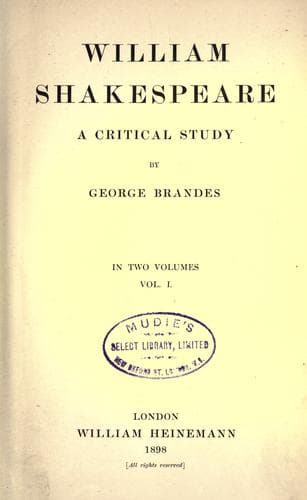
William Shakespeare: A Critical StudyBrandes, Georg
General
William Shakespeare: A Critical Study
Brandes, Georg
Shakespeare, William, 1564-1616 -- Criticism and interpretation
The answer is to be found in the point of time at which the play
was written. It was that eventful year when Shakespeare's earliest
friends among the great, Essex and Southampton, had set on foot their
foolhardy conspiracy against Elizabeth, and when their attempted
insurrection had ended in the death of the one, the imprisonment of
the other. He had seen how proud and nobly-disposed characters might
easily be seduced into political error, and tempted to rebellion, on
the plea of independence. It is true that there was little enough
resemblance of detail between the mere palace-revolution designed
by Essex, which should free him from his subjection to the Queen's
incalculable caprices, and the attempt of the Roman patricians to
liberate an aristocratic republic, by assassination, from the yoke of
a newly-founded despotism. The point of resemblance lay in the mere
fact of the imprudent and ill-starred attempt to effect a subversion of
public order.
Add to this the fact that Shakespeare, in the present stage of his
career, displays a certain preference for characters who, in spite of
noble qualities, have fortune against them and are unable to bring
their projects to a successful issue. While he himself was still
fighting for his position, Henry V., the man of practical genius,
the born victor and conqueror, had been his ideal; now that he stood
on firm ground, and was soon to reach the height of his reputation,
he seems to have turned with a sort of melancholy predilection to
characters like Brutus and Hamlet, who, in spite of the highest
endowments, proved unequal to the tasks proposed to them.[1]. They
appealed to him as profound dreamers and high-minded idealists. He
found something of their nature, too, in his own.
A good score of years earlier, in 1579, North's version of Plutarch's
parallel biographies had been published, not translated from the
original, but from the French translation of Amyot. In this book
Shakespeare found his material.
Public-domain text, read in full here on John Shaqi.
Reviews
Reviews
No reviews yet
Be the first to share your thoughts on this work.
Elsewhere in the archive
Join the Discussion
Join the discussion
Sign in to leave a comment or review.
Sign InorCreate an account