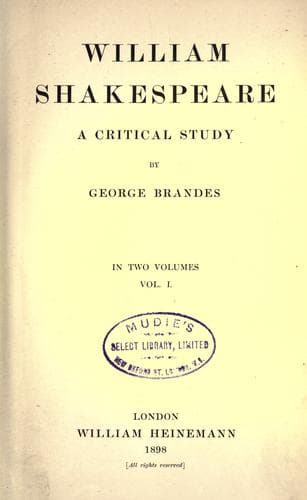
William Shakespeare: A Critical StudyBrandes, Georg
General
William Shakespeare: A Critical Study
Brandes, Georg
Shakespeare, William, 1564-1616 -- Criticism and interpretation
In dealing with the great figure of Cæsar, which gives the play
its name, Shakespeare follows faithfully the detached, anecdotic
indications of Plutarch; but he, strangely enough, seems altogether
to miss the remarkable impression we receive from Plutarch of Cæsar's
character, which, for the rest, the Greek historian himself was not
in a position fully to understand. We must not forget the fact, of
which Shakespeare of course knew nothing, that Plutarch, who was born
a century after Cæsar's death, at a time when the independence of
Greece was only a memory, and the once glorious Hellas was part of a
Roman province, wrote his comparative biographies to remind haughty
Rome that Greece had a great man to oppose to each of her greatest
sons. Plutarch was saturated with the thought that conquered Greece was
Rome's lord and master in every department of the intellectual life.
He delivered Greek lectures in Rome and could not speak Latin, while
every Roman spoke Greek to him and understood it as well as his native
tongue. Significantly enough, Roman literature and poetry do not exist
for Plutarch, though he incessantly cites Greek authors and poets. He
never mentions Virgil or Ovid. He wrote about his great Romans as an
enlightened and unprejudiced Pole might in our days write about great
Russians. He, in whose eyes the old republics shone transfigured, was
not specially fitted to appreciate Cæsar's greatness.
Shakespeare, having so arranged his drama that Brutus should be
its tragic hero, had to concentrate his art on placing him in the
foreground, and making him fill the scene. The difficulty was not
to let his lack of political insight (in the case of Antony), or
of practical sense (in his quarrel with Cassius), detract from the
impression of his superiority. He had to be the centre and pivot
of everything, and therefore Cæsar was diminished and belittled to
such a degree, unfortunately, that this matchless genius in war and
statesmanship has become a miserable caricature.
We find in other places clear indications that Shakespeare knew very
well what this man was and was worth. Edward's young son, in _Richard
III_., speaks with enthusiasm of Cæsar as that conqueror whom death has
not conquered; Horatio, in the almost contemporary _Hamlet_, speaks
of "mightiest Julius" and his death; and Cleopatra, in _Antony and
Cleopatra_, is proud of having been the mistress of Cæsar. It is true
that in _As You Like It_ the playful Rosalind uses the expression,
"Cæsar's thrasonical brag," with reference to the famous _Veni, vidi,
vici,_ but in an entirely jocose context and acceptation.
Public-domain text, read in full here on John Shaqi.
Reviews
Reviews
No reviews yet
Be the first to share your thoughts on this work.
Elsewhere in the archive
Join the Discussion
Join the discussion
Sign in to leave a comment or review.
Sign InorCreate an account