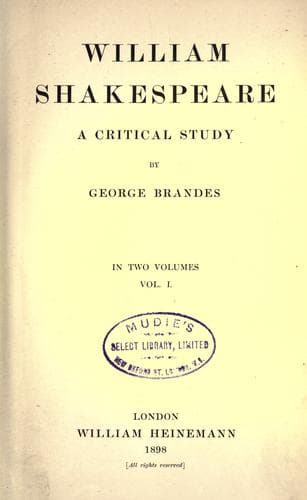
William Shakespeare: A Critical StudyBrandes, Georg
General
William Shakespeare: A Critical Study
Brandes, Georg
Shakespeare, William, 1564-1616 -- Criticism and interpretation
But here! here Cæsar has become in effect no little of a braggart,
and is compounded, on the whole, of anything but attractive
characteristics. He produces the impression of an invalid. His
liability to the "falling sickness," is emphasised. He is deaf of one
ear. He has no longer his old strength. He faints when the crown is
offered to him. He envies Cassius because he is a stronger swimmer.
He is as superstitious as an old woman. He rejoices in flattery,
talks pompously and arrogantly, boasts of his firmness and is for
ever wavering. He acts incautiously and unintelligently, and does not
realise what threatens him, while every one else sees it clearly.
Shakespeare dared not, says Gervinus, arouse too great interest in
Cæsar; he had to throw into relief everything about him that could
account for the conspiracy; and, moreover, he had Plutarch's distinct
statement that Cæsar's character had greatly deteriorated shortly
before his death. Hudson practically agrees with this, holding that
Shakespeare wished to present Cæsar as he appeared in the eyes of the
conspirators, so that "they too might have fair and equal judgment at
our hands;" admitting, for the rest, that "Cæsar was literally too
great to be seen by them," and that "Cæsar is far from being himself
in these scenes; hardly one of the speeches put in his mouth can be
regarded as historically characteristic." Thus Hudson arrives at the
astonishing result that "there is an undertone of irony at work in the
ordering and tempering of this composition," explaining that, "when
such a shallow idealist as Brutus is made to overtop and outshine the
greatest practical genius the world ever saw," we are bound to assume
that the intention is ironical.
This is the emptiest cobweb-spinning. There is no trace of irony in
the representation of Brutus. Nor can we fall back upon the argument
that Cæsar, after his death, becomes the chief personage of the drama,
and as a corpse, as a memory, as a spirit, strikes down his murderers.
How can so small a man cast so great a shadow! Shakespeare, of course,
intended to show Cæsar as triumphing after his death. He has changed
Brutus's evil genius, which appears to him in the camp and at Philippi,
into Cæsar's ghost; but this ghost is not sufficient to rehabilitate
Cæsar in our estimation.
Nor is it true that Cæsar's greatness would have impaired the unity
of the piece. Its poetic value, on the contrary, suffers from his
pettiness. The play might have been immeasurably richer and deeper than
it is, had Shakespeare been inspired by a feeling of Cæsar's greatness.
Elsewhere in Shakespeare one marvels at what he has made out of poor
and meagre material. Here, history was so enormously rich, that his
poetry has become poor and meagre in comparison with it.
Public-domain text, read in full here on John Shaqi.
Reviews
Reviews
No reviews yet
Be the first to share your thoughts on this work.
Elsewhere in the archive
Join the Discussion
Join the discussion
Sign in to leave a comment or review.
Sign InorCreate an account