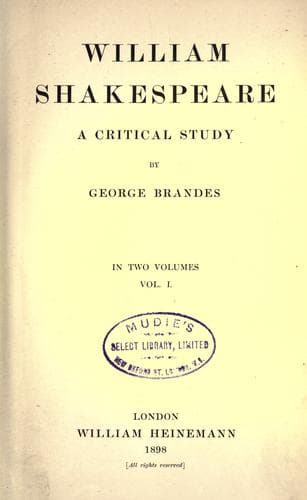
William Shakespeare: A Critical StudyBrandes, Georg
General
William Shakespeare: A Critical Study
Brandes, Georg
Shakespeare, William, 1564-1616 -- Criticism and interpretation
Brutus inherited his uncle Cato's hatred for Cæsar. A certain brutality
was united with a noble stoicism in these two last Roman republicans
of the time of the Republic's downfall. The rawness of antique Rome
survived in Cato's nature, and Brutus, in his conduct towards the
towns of the Asiatic provinces, was nothing but a bloodthirsty usurer,
who, in the name of a man of straw (Scaptius) extorted from them his
exorbitant interests with threats of fire and sword. He had lent to
the inhabitants of the town of Salamis a sum of money at 48 per cent.
On their failure to pay, he kept their Senate so closely besieged by a
squadron of cavalry that five senators died of starvation. Shakespeare,
in his ignorance, attributes no such vices to Brutus, but makes him
simple and great, at Cæsar's expense.
Cæsar as opposed to Cato--and afterwards as opposed to Brutus--is
the many-sided genius who loves life and action and power, in
contradistinction to the narrow Puritan who hates such emancipated
spirits, partly on principle, partly from instinct.
What a strange misunderstanding that Shakespeare--himself a lover
of beauty, intent on a life of activity, enjoyment, and satisfied
ambition, who always stood to Puritanism in the same hostile relation
in which Cæsar stood--should out of ignorance take the side of
Puritanism in this case, and so disqualify himself from extracting from
the rich mine of Cæsar's character all the gold contained in it. In
Shakespeare's Cæsar we find nothing of the magnanimity and sincerity
of the real man. He never assumed a hypocritical reverence towards the
past, not even on questions of grammar. He grasped at power and seized
it, but did not, as in Shakespeare, pretend to reject it. Shakespeare
has let him keep the pride which he in fact displayed, but has made it
unbeautiful, and eked it out with hypocrisy.
This further trait, too, in Cæsar's character Shakespeare has failed
to understand. When at last, after having conquered on every side,
in Africa as in Asia, in Spain as in Egypt, he held in his hands
the sovereign power which had been the object of his twenty years'
struggle, it had lost its attraction for him. Knowing that he was
misunderstood and hated by those whose respect he prized the most,
he found himself compelled to make use of men whom he despised, and
contempt for humanity took possession of his mind. He saw nothing
around him but greed and treachery. Power had lost all its sweetness
for him, life itself was no longer worth living, worth preserving.
Hence his answer when he was besought to take measures against his
would-be assassins: "Rather die once than tremble always!" and he went
to the Senate on the 15th of March without arms and without a guard. In
the tragedy, the motives which ultimately lure him thither are the hope
of a title and a crown, and the fear of being esteemed a coward.
Public-domain text, read in full here on John Shaqi.
Reviews
Reviews
No reviews yet
Be the first to share your thoughts on this work.
Elsewhere in the archive
Join the Discussion
Join the discussion
Sign in to leave a comment or review.
Sign InorCreate an account