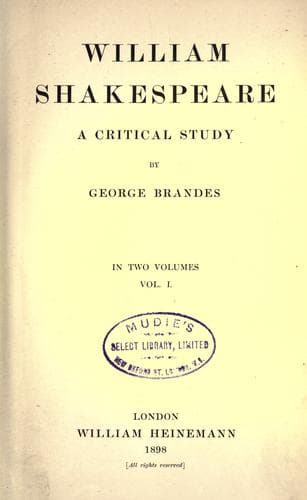
William Shakespeare: A Critical StudyBrandes, Georg
General
William Shakespeare: A Critical Study
Brandes, Georg
Shakespeare, William, 1564-1616 -- Criticism and interpretation
Those foolish persons who attribute Shakespeare's works to Francis
Bacon argue, amongst other things, that such an insight into Roman
antiquity as is manifested in _Julius Cæsar_ could be attained by no
one who did not possess Bacon's learning. On the contrary, this play
is obviously written by a man whose learning was in no sense on a
level with his genius, so that its faults, no less than its merits,
afford a proof, however superfluous, that Shakespeare himself was the
author of Shakespeare's works. Bunglers in criticism never realise to
what an extent genius can supply the place of book-learning, and how
vastly greater is its importance. But, on the other hand, one is bound
to declare unequivocally that there are certain domains in which no
amount of genius can compensate for reconstructive insight and study
of recorded fact, and where even the greatest genius falls short when
it tries to create out of its own head, or upon a scanty basis of
knowledge.
Such a domain is that of historical drama, when it deals with periods
and personalities in regard to which recorded fact surpasses all
possible imagination. Where history is stranger and more poetic than
any poetry, more tragic than any antique tragedy, there the poet
requires many-sided insight in order to rise to the occasion. It was
because of Shakespeare's lack of historical and classical culture that
the incomparable grandeur of the figure of Cæsar left him unmoved. He
depressed and debased that figure to make room for the development
of the central character in his drama--to wit, Marcus Brutus, whom,
following Plutarch's idealising example, he depicted as a stoic of
almost flawless nobility.
[1] Compare Dowden, _Shakspere_, p. 280.
[2] Mommsen, _History of Rome_, translated by W. P. Dickson, ed. 1894,
vol. v. p. 371. Gaston Boissier, _Cicéron et ses Amis_, p. 224
IX
_JULIUS CÆSAR--THE MERITS OF THE DRAMA--BRUTUS_
None but a naïve republican like Swinburne can believe that it was by
reason of any republican enthusiasm in Shakespeare's soul that Brutus
became the leading character. He had assuredly no systematic political
conviction, and manifests at other times the most loyal and monarchical
habit of mind.
Public-domain text, read in full here on John Shaqi.
Reviews
Reviews
No reviews yet
Be the first to share your thoughts on this work.
Elsewhere in the archive
Join the Discussion
Join the discussion
Sign in to leave a comment or review.
Sign InorCreate an account