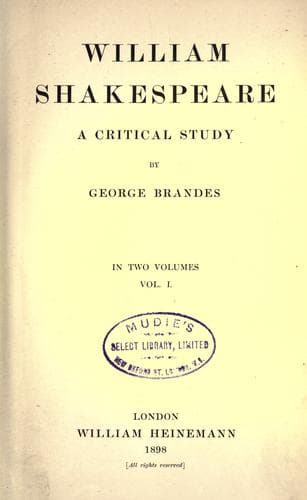
William Shakespeare: A Critical StudyBrandes, Georg
General
William Shakespeare: A Critical Study
Brandes, Georg
Shakespeare, William, 1564-1616 -- Criticism and interpretation
From the moment Cassius has spoken to him, he is sleepless. The rugged
Macbeth becomes sleepless after he has killed the King--"Macbeth has
murdered sleep." Brutus, with his delicate, reflective nature, bent
on obeying only the dictates of duty, is calm after the murder, but
sleepless before it. His preoccupation with the idea has altered
his whole manner of being; his wife does not know him again. She
tells how he can neither converse nor sleep, but strides up and down
with his arms folded, sighing and lost in thought, does not answer
her questions, and, when she repeats them, waves her off with rough
impatience.
It is not only his gratitude to Cæsar that keeps Brutus in torment;
it is especially his uncertainty as to what Cæsar's intentions really
are. Brutus sees him, indeed, idolised by the people and endowed
with supreme power; but as yet Cæsar has never abused it. He concurs
with Cassius's view that when Cæsar declined the crown he in reality
hankered after it; but, after all, they have nothing to go upon but his
supposed desire:--
"To speak truth of Cæsar,
I have not known when his affections sway'd
More than his reason. But 'tis a common proof
That lowliness is young ambition's ladder."
If Cæsar is to be slain, then, it is not for what he has done, but for
what he may do in the future. Is it permissible to commit a murder upon
such grounds?
In Hamlet we find this variant of the difficulty: Is it certain that
the king murdered Hamlet's father? May not the ghost have been a
hallucination, or the devil himself?
Brutus feels the weakness of his basis of action the more clearly
the more he leans towards the murder as a political duty. And
Shakespeare has not hesitated to attribute to him, high-minded as he
is, that doctrine of expediency, so questionable in the eyes of many,
which declares that a necessary end sanctifies impure means. Two
separate times, once when he is by himself, and once in addressing the
conspirators, he recommends political hypocrisy as judicious and
serviceable. In the soliloquy he says (II. I):--
"And, since the quarrel
Will bear no colour for the thing he is,
Fashion it thus: that what he is, augmented,
Would run to these and these extremities."
To the conspirators his words are:--
"And let our hearts, as subtle masters do,
Stir up their servants to an act of rage,
And after seem to chide 'em."
That is to say, the murder is to be carried out with as much decency as
possible, and the murderers are afterwards to pretend that they deplore
it.
Public-domain text, read in full here on John Shaqi.
Reviews
Reviews
No reviews yet
Be the first to share your thoughts on this work.
Elsewhere in the archive
Join the Discussion
Join the discussion
Sign in to leave a comment or review.
Sign InorCreate an account