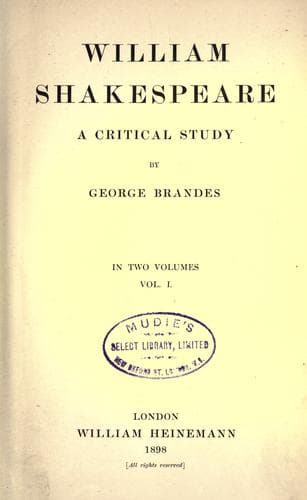
William Shakespeare: A Critical StudyBrandes, Georg
General
William Shakespeare: A Critical Study
Brandes, Georg
Shakespeare, William, 1564-1616 -- Criticism and interpretation
Brutus was already in Plutarch the protagonist of the Cæsar tragedy,
and Shakespeare followed the course of history as represented by
Plutarch, under the deep impression that an impolitic revolt, like
that of Essex and his companions, can by no means stem the current
of the time, and that practical errors revenge themselves quite as
severely as moral sins--nay, much more so. The psychologist was now
awakened in him, and he found it a fascinating task to analyse and
present a man who finds a mission imposed upon him for which he is by
nature unfitted. It is no longer outward conflicts like that in _Romeo
and Juliet_ between the lovers and their surroundings, or in _Richard
III._, between Richard and the world at large, that fascinate him in
this new stage of his development, but the inner processes and crises
of the spiritual life.
Brutus has lived among his books and fed his mind upon Platonic
philosophy; therefore he is more occupied with the abstract political
idea of republican freedom, and the abstract moral conception of the
shame of enduring a despotism, than with the actual political facts
before his eyes, or the meaning of the changes which are going on
around him. This man is vehemently urged by Cassius to place himself at
the head of a conspiracy against his fatherly benefactor and friend.
The demand throws his whole nature into a ferment, disturbs its
harmony, and brings it for ever out of equilibrium.
On Hamlet also, who is at the same time springing to life in
Shakespeare's mind, the spirit of his murdered father imposes the duty
of becoming an assassin, and the claim acts as a stimulus, a spur to
his intellectual faculties, but as a solvent to his character; so
close is the resemblance between the situation of Brutus, with his
conflicting duties, and the inward strife which we are soon to find in
Hamlet.
Brutus is at war with himself, and therefore forgets to show others
attention and the outward signs of friendship. His comrades summon him
to action, but he hears no answering summons from within. As Hamlet
breaks out into the well known words:--
"The time is out of joint:--O, cursed spite
That ever I was born to set it right!"
so also Brutus shrinks with horror from his task. He says (I. 2):--
"Brutus had rather be a villager
Than to repute himself a son of Rome
Under these hard conditions as this time
Is like to lay upon us."
His noble nature is racked by these doubts and uncertainties.
Public-domain text, read in full here on John Shaqi.
Reviews
Reviews
No reviews yet
Be the first to share your thoughts on this work.
Elsewhere in the archive
Join the Discussion
Join the discussion
Sign in to leave a comment or review.
Sign InorCreate an account