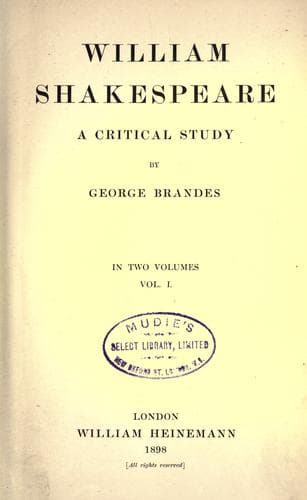
William Shakespeare: A Critical StudyBrandes, Georg
General
William Shakespeare: A Critical Study
Brandes, Georg
Shakespeare, William, 1564-1616 -- Criticism and interpretation
Even Brutus's own speech Shakespeare has moulded with the rarest
art. Plutarch relates that when Brutus wrote Greek he cultivated a
"compendious" and laconic style, of which the historian adduces a
string of examples. He wrote to the Samians: "Your councels be long,
your doings be slow; consider the end." And in another epistle: "The
Xanthians, despising my good wil, haue made a graue of dispaire; and
the Patareians, that put themselves into my protection, have lost no
iot of their liberty: and therefore whilst you haue libertie, either
chuse the iudgement of the Patareians or the fortune of the Xanthians."
See now, what Shakespeare has made out of these indications:--
"Romans, countrymen, and lovers! hear me for my cause, and
be silent, that you may hear: believe me for mine honour,
and have respect to mine honour, that you may believe.
... If there be any in this assembly, any dear friend of
Cæsar's, to him I say, that Brutus' love to Cæsar was no
less than his. If, then, that friend demand, why Brutus rose
against Cæsar, this is my answer:--Not that I loved Cæsar
less, but that I loved Rome more."
And so on, in this style of laconic antithesis. Shakespeare has made a
deliberate effort to assign to Brutus the diction he had cultivated,
and, with his inspired faculty of divination, has, as it were,
reanimated it:--
"As Cæsar loved me, I weep for him; as he was fortunate, I
rejoice at it; as he was valiant, I honour him: but, as he
was ambitious, I slew him."
With ingenious and yet noble art the speech culminates in the question,
"Who is here so vile that will not love his country! If any, speak; for
him have I offended." And when the crowd answers, "None, Brutus, none,"
he chimes in with the serene assurance, "Then none have I offended."
The still more admirable oration of Antony is in the first place
remarkable for the calculated difference of style which it displays.
Here we have no antitheses, no literary eloquence; but a vernacular
eloquence of the most powerful demagogic type. Antony takes up the
thread just where Brutus has dropped it, expressly assures his hearers
at the outset that this is to be a speech over Cæsar's bier, but
not to his glory, and emphasises to the point of monotony the fact
that Brutus and the other conspirators are all, all honourable men.
Then the eloquence gradually works up, subtle and potent, in its
adroit crescendo, and yet in truth exalted by something which is not
subtlety: glowing enthusiasm for Cæsar, scathing indignation against
his assassins. The contempt and anger are at first masked, out of
consideration for the mood of the populace, which has for the moment
been won over by Brutus; then the mask is raised a little, then a
little more and a little more, until, with a wild gesture, it is torn
off and thrown aside.
Here again Shakespeare has utilised in a masterly fashion the hints he
found in Plutarch, scanty as they were:--
Public-domain text, read in full here on John Shaqi.
Reviews
Reviews
No reviews yet
Be the first to share your thoughts on this work.
Elsewhere in the archive
Join the Discussion
Join the discussion
Sign in to leave a comment or review.
Sign InorCreate an account