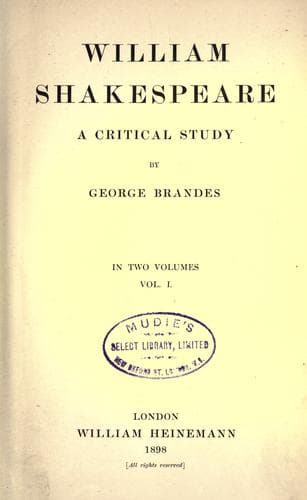
William Shakespeare: A Critical StudyBrandes, Georg
General
William Shakespeare: A Critical Study
Brandes, Georg
Shakespeare, William, 1564-1616 -- Criticism and interpretation
"Afterwards, when Cæsar's body was brought into the
market-place, Antonius, making his funeral oration in praise
of the dead, according to the auncient custome of Rome,
and perceiuing that his words moued the common people to
compassion: he framed his eloquence to make their harts
yerne the more."
Mark what Shakespeare has made of this::--
"Friends, Romans, countrymen, lend me your ears:
I come to bury Cæsar, not to praise him.
The evil that men do lives after them,
The good is oft interred with their bones;
So let it be with Cæsar. The noble Brutus
Hath told you, Cæsar was ambitious:
If it were so, it was a grievous fault,
And grievously hath Cæsar answered it.
Here, under leave of Brutus and the rest,
(For Brutus is an honourable man,
So are they all, all honourable men),
Come I to speak in Cæsar's funeral.
He was my friend, faithful and just to me:
But Brutus says he was ambitious;
And Brutus is an honourable man."
Then Antony goes on to insinuate doubts as to Cæsar's ambition, and
tells how he rejected the kingly diadem, rejected it three times. Was
this ambition? Thereupon he suggests that Cæsar, after all, was once
beloved, and that there is no reason why he should not be mourned. Then
with a sudden outburst:--
"O judgment! thou art fled to brutish beasts,
And men have lost their reason!--Bear with me;
My heart is in the coffin there with Cæsar,
And I must pause till it come back to me."
Next comes an appeal to their pity for this greatest of men, whose
word but yesterday might have stood against the world, and who now
lies so low that the poorest will not do him reverence. It would be
wrong to make his speech inflammatory, a wrong towards Brutus and
Cassius "who--as you know--are honourable men" (mark the jibe in the
parenthetic phrase); no, he will rather do wrong to the dead and to
himself. But here he holds a parchment--he assuredly will not read
it--but if the people came to know its contents they would kiss dead
Cæsar's wounds, and dip their handkerchiefs in his sacred blood. And
then, when cries for the reading of the will mingle with curses upon
the murderers, he stubbornly refuses to read it. Instead of doing so,
he displays to them Cæsar's cloak with all the rents in it.
What Plutarch says here is:--
"To conclude his Oration, he unfolded before the whole
assembly the bloudy garments of the dead, thrust through in
many places with their swords, and called the malefactors
cruell and cursed murtherers."
Out of these few words Shakespeare has made this miracle of invective:--
Public-domain text, read in full here on John Shaqi.
Reviews
Reviews
No reviews yet
Be the first to share your thoughts on this work.
Elsewhere in the archive
Join the Discussion
Join the discussion
Sign in to leave a comment or review.
Sign InorCreate an account