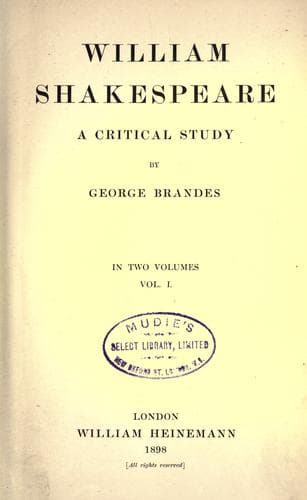
William Shakespeare: A Critical StudyBrandes, Georg
General
William Shakespeare: A Critical Study
Brandes, Georg
Shakespeare, William, 1564-1616 -- Criticism and interpretation
This scene is significant because it gives a many-sided picture of the
two leading characters--the sternly upright Brutus, who is shocked at
the means employed by Cassius to raise the money without which their
campaign cannot be carried on, and Cassius, a politician entirely
indifferent to moral scruples, but equally unconcerned as to his own
personal advantage. The scene is profound because it presents to us the
necessary consequences of the law-defying, rebellious act: cruelty,
unscrupulous policy, and lax tolerance of dishonourable conduct in
subordinates, when the bonds of authority and discipline have once been
burst. The scene is brilliantly constructed because, with its quick
play of passion and its rising discord, which at last passes over into
a cordial and even tender reconciliation, it is dramatic in the highest
sense of the word.
The fact that Brutus was in Shakespeare's own mind the true hero of the
tragedy appears in the clearest light when we find him ending the play
with the eulogy which Plutarch, in his life of Brutus, places in the
mouth of Antony; I mean the famous words:--
"This was the noblest Roman of them all:
All the conspirators, save only he,
Did that they did in envy of great Cæsar;
He only, in a general honest thought
And common good to all, made one of them.
His life was gentle; and the elements
So mixed in him that Nature might stand up,
And say to all the world, 'This was a man!'"
The resemblance between these words and a celebrated speech of Hamlet's
is unmistakable. Everywhere in _Julius Cæsar_ we feel the proximity of
_Hamlet_. The fact that Hamlet hesitates so long before attacking the
King, finds so many reasons to hold his hand, is torn with doubts as
to the act and its consequences, and insists on considering everything
even while he upbraids himself for considering so long--all this is
partly due, no doubt, to the circumstance that Shakespeare comes to
him directly from Brutus. His Hamlet has, so to speak, just seen what
happened to Brutus, and the example is not encouraging, either with
respect to action in general, or with respect to the murder of a
stepfather in particular.
It is not difficult to conceive that Shakespeare may at this period
have been subject to moments of scepticism, in which he could scarcely
understand how any one could make up his mind to act, to assume
responsibility, to set in motion the rolling stone which is the type
of every action. If we once begin to brood over the incalculable
consequences of an action and all that circumstance may make of it,
all action on a great scale becomes impossible. Therefore it is that
very few old men understand their youth; they dare not and could not
act again as, in their recklessness of consequences, they acted then.
Brutus forms the transition to Hamlet, and Hamlet no doubt grew up in
Shakespeare's mind during the working out of _Julius Cæsar_.
Public-domain text, read in full here on John Shaqi.
Reviews
Reviews
No reviews yet
Be the first to share your thoughts on this work.
Elsewhere in the archive
Join the Discussion
Join the discussion
Sign in to leave a comment or review.
Sign InorCreate an account