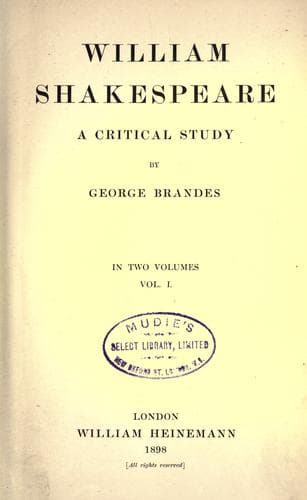
William Shakespeare: A Critical StudyBrandes, Georg
General
William Shakespeare: A Critical Study
Brandes, Georg
Shakespeare, William, 1564-1616 -- Criticism and interpretation
"You all do know this mantle! I remember
The first time ever Cæsar put it on:
'Twas on a summer's evening, in his tent,
That day he overcame the Nervii.
Look! in this place ran Cassius' dagger through:
See, what a rent the envious Casca made:
Through this, the well-beloved Brutus stabb'd;
And, as he pluck'd his cursed steel away,
Mark how the blood of Cæsar followed it,
As rushing out of doors, to be resolv'd
If Brutus so unkindly knock'd, or no;
For Brutus, as you know, was Cæsar's angel.
Judge, O you gods, how dearly Cæsar lov'd him!
This was the most unkindest cut of all;
For when the noble Cæsar saw him stab,
Ingratitude, more strong than traitors' arms,
Quite vanquish'd him: then burst his mighty heart;
And, in his mantle muffling up his face,
Even at the base of Pompey's statua,
Which all the while ran blood, great Cæsar fell.
O, what a fall was there, my countrymen!
Then I, and you, and all of us fell down,
Whilst bloody treason flourish'd over us.
O! now you weep; and, I perceive, you feel
The dint of pity: these are gracious drops.
Kind souls! what, weep you, when you but behold
Our Cæsar's vesture wounded? Look you here,
Here is himself, marr'd, as you see, with traitors."
He uncovers Cæsar's body; and not till then does he read the will,
overwhelming the populace with gifts and benefactions. This climax is
of Shakespeare's own invention.
No wonder that even Voltaire was so struck with the beauty of this
scene, that for its sake he translated the first three acts of the
play. At the end of his own _Mort de César_, too, he introduced a
feeble imitation of the scene; and he had it in his mind when, in his
_Discours sur la Tragédie_, dedicated to Bolingbroke, he expressed so
much enthusiasm and envy for the freedom of the English stage.
In the last two acts, Brutus is overtaken by the recoil of his deed.
He consented to the murder out of noble, disinterested and patriotic
motives; nevertheless he is struck down by its consequences, and pays
for it with his happiness and his life. The declining action of the
last two acts is--as is usual with Shakespeare--less effective and
fascinating than the rising action which fills the first three; but it
has one significant, profound, and brilliantly constructed and executed
scene--the quarrel and reconciliation between Brutus and Cassius in the
fourth act, which leads up to the appearance of Cæsar's ghost.
Public-domain text, read in full here on John Shaqi.
Reviews
Reviews
No reviews yet
Be the first to share your thoughts on this work.
Elsewhere in the archive
Join the Discussion
Join the discussion
Sign in to leave a comment or review.
Sign InorCreate an account